Clark Bryan is an award-winning concert pianist and recording artist. He has studied with some of the greatest pianists of our times. With more than a dozen albums to his credit, Clark has also recorded over two thousand piano works since the Pandemic. As a teacher, Bryan has taught thousands of students, adjudicated more than 75 music festivals coast-to-coast in Canada, given dozens of workshops and written a book, “Gateways to Learning and Memory”. In 2004, he founded The Aeolian Performing Arts Centre. Today, this historic and legendary Centre is recognized as a beacon for arts and culture in Ontario and regularly hosts musical artists of many genres and is prized for the gift of intimacy and acoustics it provides to both audiences and performers. Bryan believes that everyone should have universal access to music, art, education, and culture. Because of this belief, he launched El Sistema Aeolian in 2011. This free, UNESCO award-winning program has offered more than a thousand children and youth an opportunity to experience the joy of a rich musical education. “Music is one of the most powerful tools we have for social change,” he says. In all his work with the arts and education work, Clark displays a progressive, social-justice mindset. Other innovations have included Aeolian Pride Choruses, Rebelheart Collective, Aeolian Talks, A National Song Writing Competition and The Aeolian Jazz and Musical Arts Festival. Bryan was awarded Musical Personality of the Year (2005) and won a Jack Richardson Award for Community Contribution (2011). In 2017, Mr. Bryan was given the Western Alumni Award of Merit and inducted into the Don Wright Faculty of Music Wall of Fame. In 2018, Clark was recognized with a Canada 150 Award through the House of Commons for his contributions to community and the nation. In 2022, Clark won Best Classical Solo Musician at Forest City London Music Awards. In 2023, Bryan was featured in a book about London by renowned author Richard Bain. In 2023, Clark was awarded a Lifetime achievement award from the Forest City London Music Awards and inducted into the London Music Hall of Fame. In 2024, he was awarded The Mayor’s Honour List from The City of London. Bryan continues to extend his reach into the community. Whether speaking about the power and joy of music study in his TEDX talk or engaging in community activism, Clark is committed to community. He speaks regularly at events, is featured on radio, newsprint and television.

June 30, 2016

This coming Monday, The Aeolian is launching a brand new inittiative.

MEDIA ADVISORY                                                                                                                                                                                  FOR: Monday, July 4, 2016
New Notes About to Sound
Surprise Announcement from The Aeolian
Who: The Aeolian Musical Arts Association
When: Monday, July 4, 2016, 4:00 pm – 6:00 pm, announcement at 4:25 pm
What: Surprise Announcement
Where: The Aeolian Performing Arts Centre, 795 Dundas St East, London, ON
LONDON, June 28, 2016 – – The Aeolian is proud to be launching a brand new initiative!

Imagine an orchestra without a conductor.
Imagine orchestra concerts that include free seats.
Imagine an orchestra with a core of Canada’s best musicians.
Imagine our El Sistema students playing with these artists.
Imagine an orchestra that is accessible to everyone.
Imagine an orchestra that provides equal opportunities to youth.
Imagine an orchestra that supports social justice.
Imagine the Orchestra of the future.

At this point, all we can say is that it is big, it is the first of its kind in London, and it is world-class. On behalf of The Aeolian Musical Arts Association, we would like to invite members of the press, arts organizations, and our community partners to take part in the unveiling of our great big secret.

July 26, 2016

Last week I attended the first global Positive Education Conference “IPEN” in Dallas Texas.  There is a major movement happening to change the world for the better!  Some consider this to be a “once in five hundred years” shift.  The focus for education is moving from survival and avoiding bad outcomes to “Flourishing”.  Seligman’s model of flourishing is at the core of this movement and is embraced by leading positive psychologists and educators globally.  This model is easy to remember with  the acronym PERMA and stands for:

Positive Emotions
Engagement in positive acitivites and with positive people
Relationships that are strong and supportive
Meaning:  What’s life all about?  What makes me feel like there is a higher purpose to my life-journey?
Accomplishments:  makes us feel satisfied!

We need to balance all of these footprints/pillars to have a feeling of well-being.

I would encourage all of you to investigate this new chapter in human evolution!  IPEN:  http://ipen-festival.com

November 23, 2015

Mindfull meditation is a technique which is growing in popularity in today’s schools.  It is also used outside of the classroom as a form of reframing thoughts and emotions before a reaction to them.  It is about focusing on the present without any judgement over thought patterns or their resultant emotions.  The breath leads this form of meditation.  One focuses on the breath and how it changes.  Belly breathing is essential in this form.  One pays attention to thoughts, feelings and emotions as a detached observer.  The release from thought is to return to breath.

Today we will begin mindfull meditation at El Sistema Aeolian with the kids.  We have already had a few sessions with our teaching team and volunteers.  Mario Faveri, a renowned sports and performing artist coach  will lead this exercise over a period of days and months to come and will measure its effectivenss.  Our hope is that our kids will learn this technique and its language through practise.  We will be looking for results measuring their ability to focus on their musical accomplishments.  We will also measure the outcome in regards to their more positive social behaviour.

November 22, 2015

The Communicative Performer

A communicative performer starts out with having something to say.  What is said must be “owned” by the performer to the degree that the audience feels as if the music was composed and is spontaneous.  Authentic to me means fully embraced and starting from a place of authentic “self”.  We are all products of our influences: our experiences, teachers, parents and other relationships.  Testing out ideas against any prejudice of a teacher’s ideas must happen in order to fully communicate to our audience and colleagues (if in an ensemble).
We must be in “flow” to communicate well.  The synthesis of mind, body, emotions and spirit is flow.  The match to light flow is inspiration.  This comes from a place of passion and the need to show our audience what we see and feel.
Being open and reading our audience is also critical.  Our body language and demeanour are part of making connection.  We must use intuition to make the connection.  Intuition is that subconscious intelligence which unites all of our being; all of our experiences as well as our present and our glance  to the future.
I have found that communicating on a verbal level with an audience helps immensely.  Not the typical “old-fashioned” lecture-recital, but imagery, history and story-telling.  This must not be academic but real and personal reflections.  I have often had audience members remark that this “set-up” or “after-thought” helped them find a “way into” or “reflection” of the music.  This is especially important with longer works where attention spans are challenging for the uninitiated.
There is a kind of psychic or symbiotic relationship that occurs where the performer feels the audience on the edge of their seats and can direct them.  This is a sign that all has been achieved.
My last thought on this subject is that we must communicate from a place of love.  Many of us can recall an experience of listening to a work performed without love.  It can be a good performance.  Everyone will know and feel that something is missing.  The ingredient of love shifts the “good” to “sublime” or “ecstatic”.
Some of being a communicative performer can be taught.  The rest is a point of arrival for giving rather than receiving.  It comes after we evolve as people to the point where we are past our narcissistic egoism.  At this point, there is no more divide and conquer, but feelings of love and delight in sharing a moment of creativity with friends.
November 15, 2015

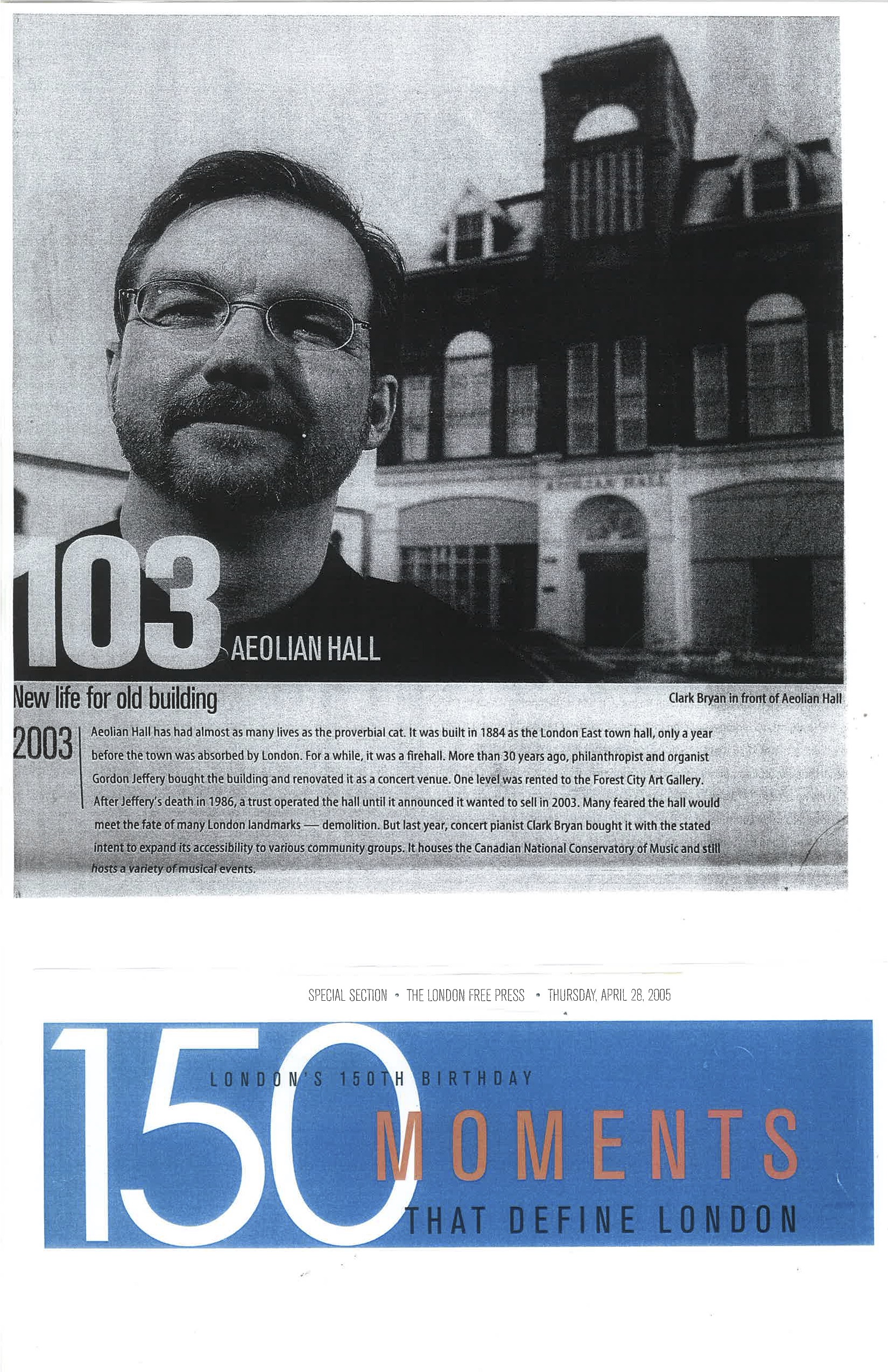
An article from many years ago after I had just bought the Aeolian:

150 Moments that define London Ontario and Clark Bryan

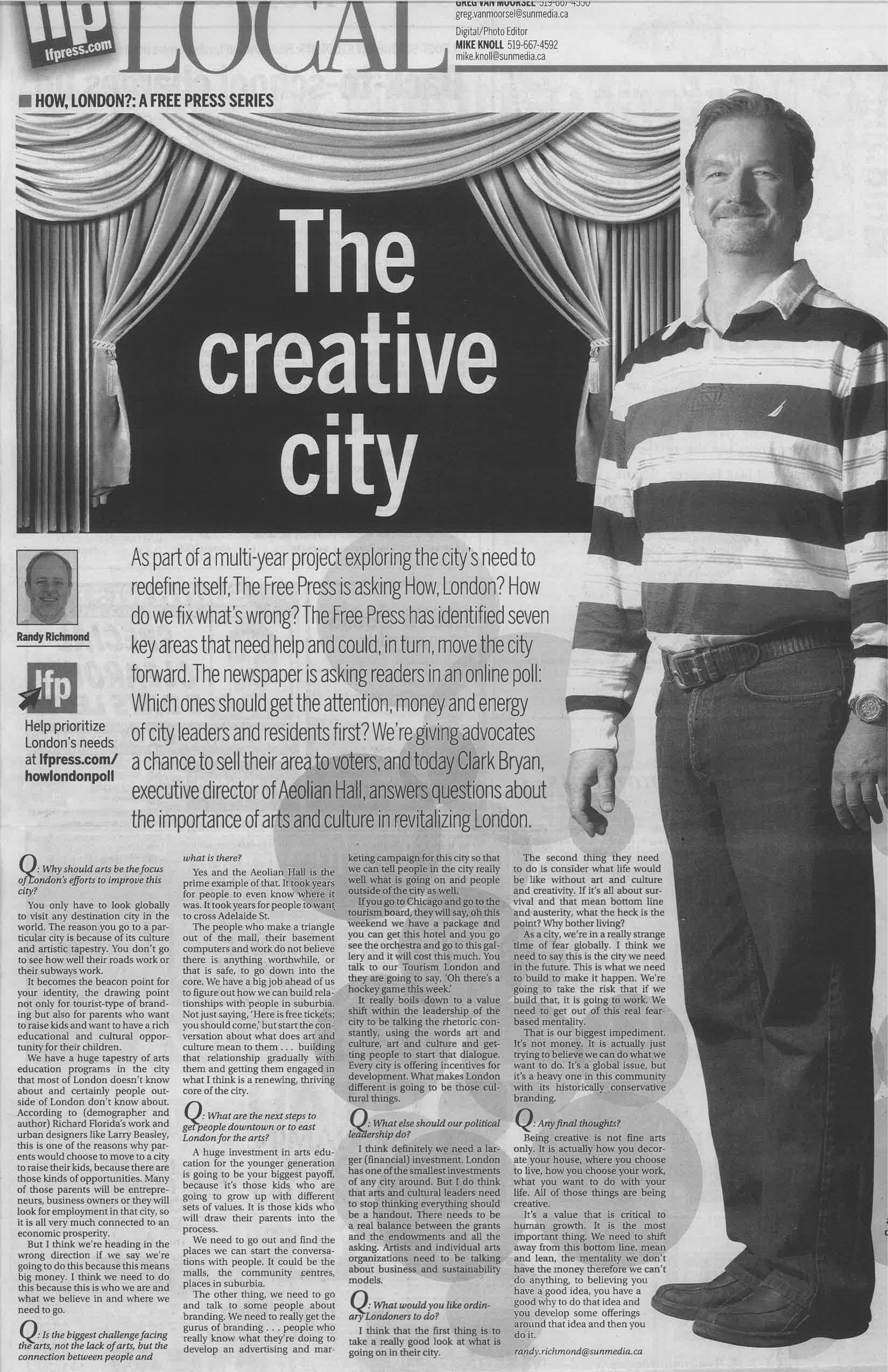
An article where I gave my opinion about Art in Culture in London (London Free Press):

Free Press Article about Culture with Clark Bryan

November 4, 2015

I had an interesting conversation recently with a music educator from academia.  We were talking about musical and social outcomes from music education programs.  If I said that program X has a great outcome, she would ask:  “what lens or you putting on for this outcome”.  This begs the question of definition for outcome.  How can we truely measure a multifaceted outcome in a meaningful way.  There are logic models we can contruct.  There are measuring tools we can make and adopt.  But how can we “define” in a “moment in time” the impact of our teaching and resultant learning.  I think we need to continue to hold the tension between our observations and the questions we haven’t even thought of yet!

September 11, 2015

Why Music?

As we move forward to advocate for music education, there is an interesting perspective to keep in mind. Most of us are aware of the benefits of studying music such as increased brain function, increased fine motor skills, self-discipline, pursuit of excellence and many other side-benefits.

It is really important to remember that the first and foremost argument for studying, playing and listening to music should always be because “it is music”. Music alone advocates for music. Its powerful transformative nature inspires us and gives us the greatest depths of pleasure. We visit many lands, cultures and lives through music. It is by far one of the greatest gifts we have as human beings. It is impossible to describe music adequately in words and that is its magic. Music transcends language and integrates its communication to us uniting our mind, body and spirit. It brings us into “flow” and gets us to the centre of our consciousness. If we remind people of this, we will awaken them to the most authentic reason for music.

July 2, 2015

William Deresiewicz recently published a book entitiled “Excellent Sheep”.  Besides outlining the failings of our educational approach in our elite systems, he focuses on “the meaningful life”.  I love his last quote of Thomas Hardy:

“The beggarly question of parentage-what is it, after all?  What does it matter, when you come to think about it, whether a child is yours by blood or not? All the little ones of our time are collectively the children of us adults of the time, and entitled to our general care.”

If we can treat every child with this fairness and equity-not to mention love, we can change the world!

which are “empty receptacles”. It’s an oppressive relationship: the teacher takes control and takes the role of an oppressor. The student is expected to be a passive follower.

Freire proposes a “problem posing” education structured to encourage thinking in students. The student and teacher enter into a partnership relationship of dialogue to jointly come to conclusions about problems. The teacher must not pre-determine solutions but these solutions must come together with the student through dialogue. The teacher and the student must learn from each other.

July 2, 2015

William Deresiewicz recently published a book entitiled “Excellent Sheep”.  Besides outlining the failings of our educational approach in our elite systems, he focuses on “the meaningful life”.  I love his last quote of Thomas Hardy:

“The beggarly question of parentage-what is it, after all?  What does it matter, when you come to think about it, whether a child is yours by blood or not? All the little ones of our time are collectively the children of us adults of the time, and entitled to our general care.”

If we can treat every child with this fairness and equity-not to mention love, we can change the world!

July 2, 2015

I recently wrote this article for El Sistema Toronto’s e-newsletter:

Building Self

El Sistema is both a social movement and an inspiring music education program. The social component is about community building and eliminating barriers to participation, but is that enough? The music education component is an enriched intensive experience for our participants, but are we just offering a conditioned traditional approach?

Education in its best form is a shared experience. It should be an atmosphere of discovery. Our students are not empty vessels needing to be filled. They are also our teachers. It’s not just our participants who can learn and grow as we teach young people, but also our teachers, administrators, volunteers, families and communities.

The positive psychology movement is casting a revolutionary framework we can use for the social/educational context of El Sistema. Seligman, one of the leaders of this movement has proposed five foundations of human needs which give us a comprehensive sense of well-being. They are: Positive Emotions, Engagement, Relationships, Meaning and Accomplishments. If we make this model the foundation of our social/education framework we can then create tools to nurture these five areas of personal and social development.

These tools and approaches will help us continue to develop our revolutionary programs and create more influence for better education approaches and social impact.