Blog
November 22, 2015
The Communicative Performer
November 22, 2015
The Communicative Performer
November 4, 2015
I had an interesting conversation recently with a music educator from academia. We were talking about musical and social outcomes from music education programs. If I said that program X has a great outcome, she would ask: “what lens or you putting on for this outcome”. This begs the question of definition for outcome. How can we truely measure a multifaceted outcome in a meaningful way. There are logic models we can contruct. There are measuring tools we can make and adopt. But how can we “define” in a “moment in time” the impact of our teaching and resultant learning. I think we need to continue to hold the tension between our observations and the questions we haven’t even thought of yet!
September 11, 2015
Why Music?
As we move forward to advocate for music education, there is an interesting perspective to keep in mind. Most of us are aware of the benefits of studying music such as increased brain function, increased fine motor skills, self-discipline, pursuit of excellence and many other side-benefits.
It is really important to remember that the first and foremost argument for studying, playing and listening to music should always be because “it is music”. Music alone advocates for music. Its powerful transformative nature inspires us and gives us the greatest depths of pleasure. We visit many lands, cultures and lives through music. It is by far one of the greatest gifts we have as human beings. It is impossible to describe music adequately in words and that is its magic. Music transcends language and integrates its communication to us uniting our mind, body and spirit. It brings us into “flow” and gets us to the centre of our consciousness. If we remind people of this, we will awaken them to the most authentic reason for music.
July 2, 2015
William Deresiewicz recently published a book entitiled “Excellent Sheep”. Besides outlining the failings of our educational approach in our elite systems, he focuses on “the meaningful life”. I love his last quote of Thomas Hardy:
“The beggarly question of parentage-what is it, after all? What does it matter, when you come to think about it, whether a child is yours by blood or not? All the little ones of our time are collectively the children of us adults of the time, and entitled to our general care.”
If we can treat every child with this fairness and equity-not to mention love, we can change the world!
which are “empty receptacles”. It’s an oppressive relationship: the teacher takes control and takes the role of an oppressor. The student is expected to be a passive follower.
Freire proposes a “problem posing” education structured to encourage thinking in students. The student and teacher enter into a partnership relationship of dialogue to jointly come to conclusions about problems. The teacher must not pre-determine solutions but these solutions must come together with the student through dialogue. The teacher and the student must learn from each other.
July 2, 2015
William Deresiewicz recently published a book entitiled “Excellent Sheep”. Besides outlining the failings of our educational approach in our elite systems, he focuses on “the meaningful life”. I love his last quote of Thomas Hardy:
“The beggarly question of parentage-what is it, after all? What does it matter, when you come to think about it, whether a child is yours by blood or not? All the little ones of our time are collectively the children of us adults of the time, and entitled to our general care.”
If we can treat every child with this fairness and equity-not to mention love, we can change the world!
July 2, 2015
I recently wrote this article for El Sistema Toronto’s e-newsletter:
Building Self
El Sistema is both a social movement and an inspiring music education program. The social component is about community building and eliminating barriers to participation, but is that enough? The music education component is an enriched intensive experience for our participants, but are we just offering a conditioned traditional approach?
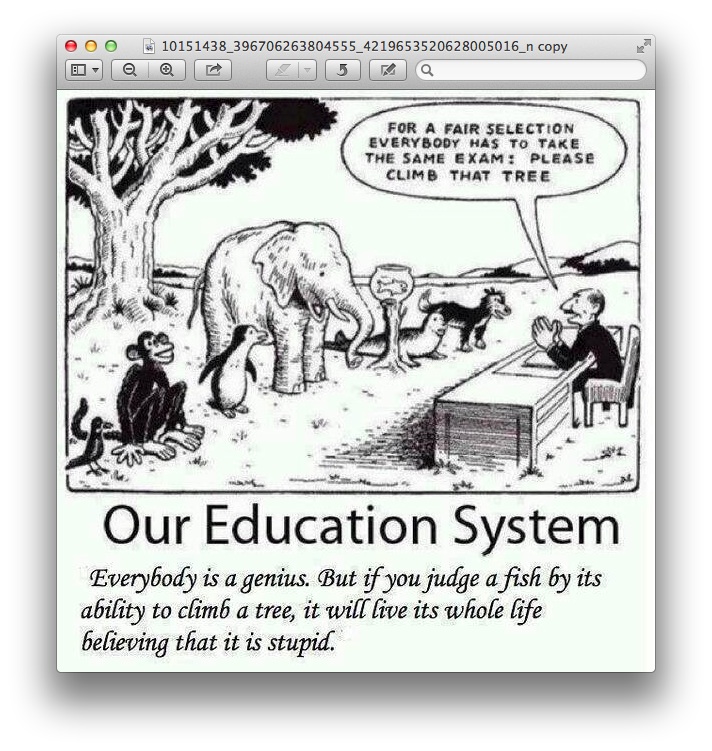
Education in its best form is a shared experience. It should be an atmosphere of discovery. Our students are not empty vessels needing to be filled. They are also our teachers. It’s not just our participants who can learn and grow as we teach young people, but also our teachers, administrators, volunteers, families and communities.
The positive psychology movement is casting a revolutionary framework we can use for the social/educational context of El Sistema. Seligman, one of the leaders of this movement has proposed five foundations of human needs which give us a comprehensive sense of well-being. They are: Positive Emotions, Engagement, Relationships, Meaning and Accomplishments. If we make this model the foundation of our social/education framework we can then create tools to nurture these five areas of personal and social development.
These tools and approaches will help us continue to develop our revolutionary programs and create more influence for better education approaches and social impact.
May 6, 2015
Norman Doidge in his book “The Brain That Changes Itself” has offered us an incredible gift. It is the beginning of the instruction book for the human brain. Although research into neuroplasticity is still in its infancy, Doidge stands at the gateway of ushering in a new era of understanding of both how the brain works and how we can change the way it works. A couple of quotes I really enjoyed:
“So a neuroplstically informed view of culture and the brain implies a two-way street: the brain and genetics produce culture, but culture also shapes the brain. Sometimes these changes can be dramatic.”
“Studies by Taub and others of musicians who play stringed instruments have shown that the more these musicians practice, the larger the brain maps for their active left hands become, and the neurons and maps that respond to string timbres increase….Brain imaging shows that musicians have several areas of their brains-the motor cortex and the cerebellum, among other-that differ from those of non musicians. Imaging also shows that musicians who begin playing before the age of seven have larger brain areas connecting the two hemispheres.”
April 21, 2015
I stumbled across a TED talk that got me thinking about how much we need to do in regards to learning and teaching opportunities. I had considered Steiner/Waldorf models of outdoor gardens and outdoor teaching, but hadn’t given thought to the shape, size and design of schools. This kindergarden school in Japan bursts the four-wall model we have all become familiar with. It nurtures activity, fitness, community, nature, play and fun! A circular environment brings children back to learning and follows their “play activities” running in circles. Tree climbing and exploration are also natural to children and can be found throughout this amazing facility. The designer makes the case for children taking risks, falling down and hurting themselves as a natural and good phenomenon!
http://www.ted.com/talks/takaharu_tezuka_the_best_kindergarten_you_ve_ever_seen