Clark Bryan is an award-winning concert pianist and recording artist. He has studied with some of the greatest pianists of our times. With more than a dozen albums to his credit, Clark has also recorded over two thousand piano works since the Pandemic. As a teacher, Bryan has taught thousands of students, adjudicated more than 75 music festivals coast-to-coast in Canada, given dozens of workshops and written a book, “Gateways to Learning and Memory”.
In 2004, he founded The Aeolian Performing Arts Centre. Today, this historic and legendary Centre is recognized as a beacon for arts and culture in Ontario and regularly hosts musical artists of many genres and is prized for the gift of intimacy and acoustics it provides to both audiences and performers.
Bryan believes that everyone should have universal access to music, art, education, and culture. Because of this belief, he launched El Sistema Aeolian in 2011. This free, UNESCO award-winning program has offered more than a thousand children and youth an opportunity to experience the joy of a rich musical education. “Music is one of the most powerful tools we have for social change,” he says. In all his work with the arts and education work, Clark displays a progressive, social-justice mindset.
Other innovations have included Aeolian Pride Choruses, Rebelheart Collective, Aeolian Talks, A National Song Writing Competition and The Aeolian Jazz and Musical Arts Festival.
Bryan was awarded Musical Personality of the Year (2005) and won a Jack Richardson Award for Community Contribution (2011). In 2017, Mr. Bryan was given the Western Alumni Award of Merit and inducted into the Don Wright Faculty of Music Wall of Fame. In 2018, Clark was recognized with a Canada 150 Award through the House of Commons for his contributions to community and the nation. In 2022, Clark won Best Classical Solo Musician at Forest City London Music Awards. In 2023, Bryan was featured in a book about London by renowned author Richard Bain. In 2023, Clark was awarded a Lifetime achievement award from the Forest City London Music Awards and inducted into the London Music Hall of Fame. In 2024, he was awarded The Mayor’s Honour List from The City of London.
Bryan continues to extend his reach into the community. Whether speaking about the power and joy of music study in his TEDX talk or engaging in community activism, Clark is committed to community. He speaks regularly at events, is featured on radio, newsprint and television.
Here’s something worth considering as we prepare to elect our school board trustees in London.
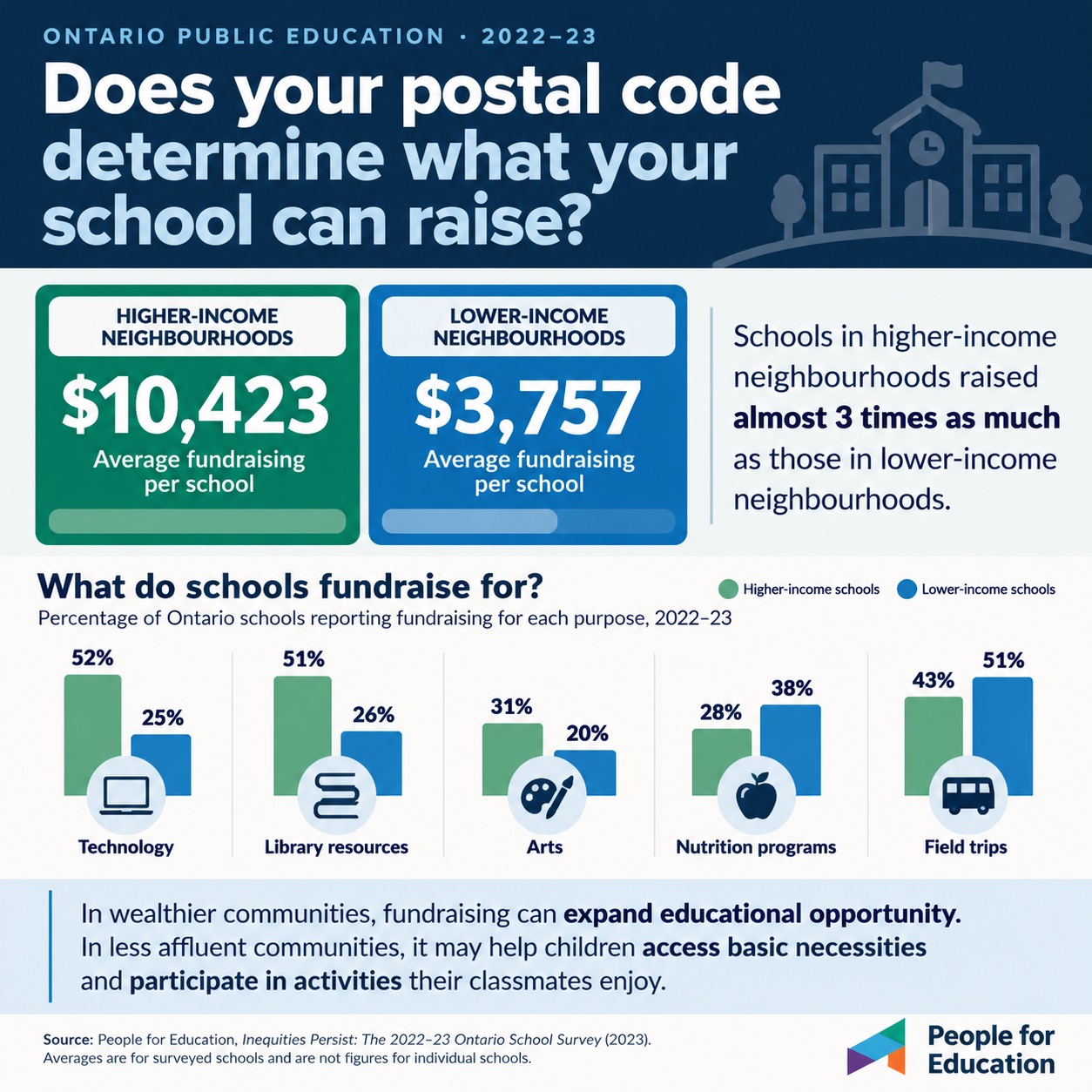
According to People for Education’s research, Ontario schools in higher-income neighbourhoods raised an average of $10,423 in 2022–23.
Schools in lower-income neighbourhoods raised just $3,757.
Almost three times the difference.
But here’s what concerns me even more:
Schools in wealthier communities were more likely to fundraise for technology, libraries and arts programming.
Schools in less affluent communities were more likely to fundraise for nutrition programs and field trips.
Think about that.
In one community, fundraising can expand educational opportunity. In another, it may help children access basic necessities and participate in activities their classmates enjoy.
And then there are the teachers.
I regularly hear from educators who purchase food, hygiene products, clothing and classroom supplies with their own money. Sometimes they even help families struggling to make ends meet.
Their generosity is extraordinary. But should our public education system depend on it?
We celebrate the principle that every child deserves an equitable education. Yet the resources available to children can still be influenced by neighbourhood wealth, charitable donations and the personal generosity of educators.
This raises important questions for anyone seeking election as a school board trustee:
How does your board identify and measure inequities between schools?
How are resources allocated to address those differences?
Should essential educational opportunities depend on fundraising?
What can trustees do to ensure that students’ needs are met, regardless of family income or postal code?
School trustees cannot solve poverty or determine provincial education funding on their own. But they do have important responsibilities for oversight, local priorities and public accountability.
Education is one of our greatest public investments. Equity should be something we can demonstrate, not simply something we promise.
I’m exploring these questions in my London School Trustee Election Primer.
Sources: People for Education, Inequities Persist (2023) and The Education Promise and Critical Resources in Canadian Schools (2026).
Here is an updated version of the London Primer. It includes recent candidate platform updates and some ideas that were sent to me that I felt were important to include. These new ideas and updates are included at the end of the document as an addendum.
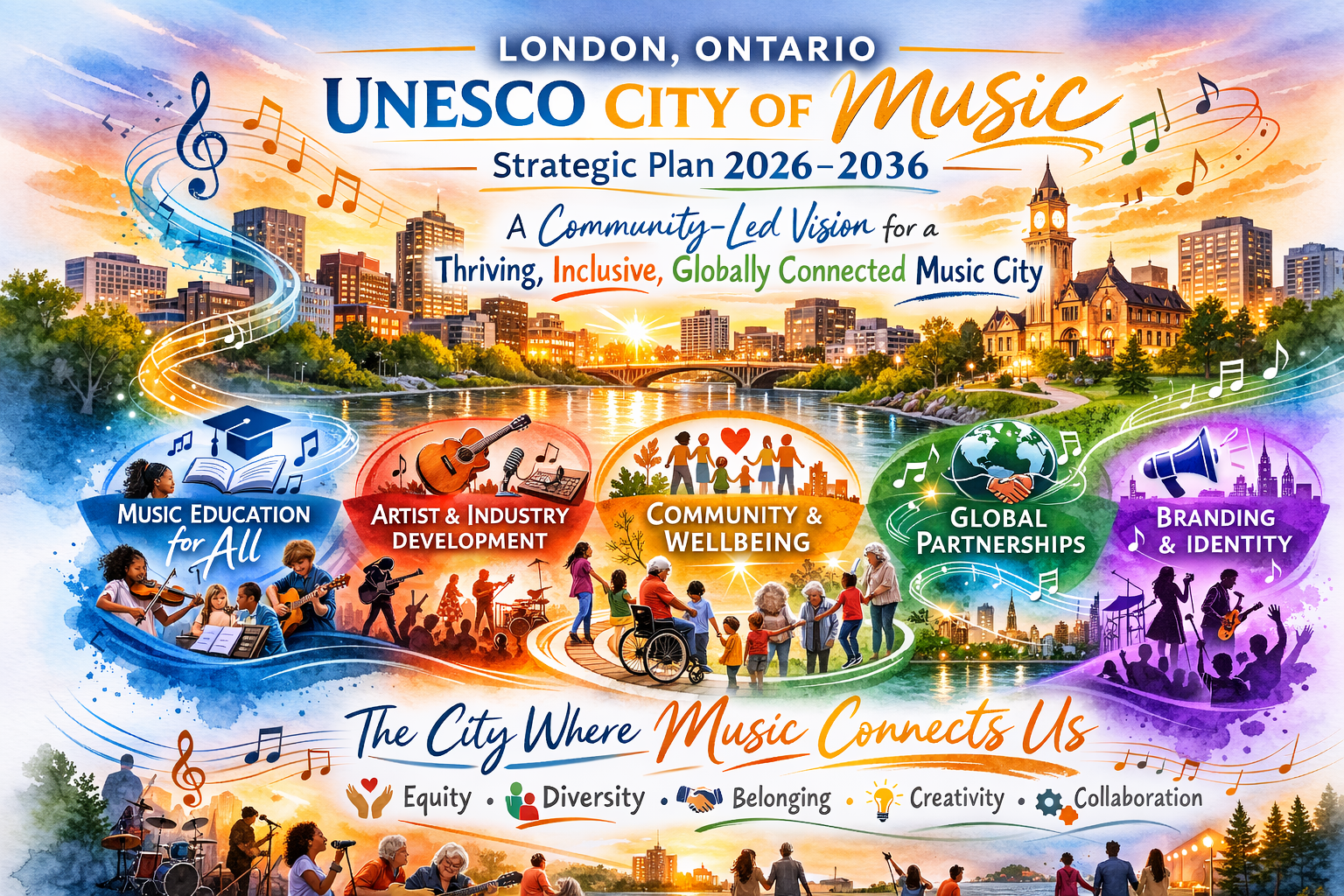
London, Ontario, Canada’s first UNESCO City of Music, is uniquely positioned to build a future where music is central to community wellbeing, identity, economic vitality, and cultural belonging. This 10-year strategy outlines a community-driven, equity-centred, globally aware approach to transforming London’s music ecosystem into a model for mid-sized urban cultural development worldwide.
Branding, Marketing & Identity Building for London
The plan prioritizes:
Diversity & Inclusion
Newcomer engagement
Youth leadership & mentorship
Seniors & intergenerational music pathways
Mental health & community wellbeing
Climate-aligned cultural practices
Collaborative governance & continuous listening
Financial adaptability & realistic implementation
A unified, values-driven London City of Music brand
Above all, this strategy affirms that:
Music is not merely an industry — it is a public good, a cultural language, a community asset, and a source of identity and belonging.
Economic development, tourism, and job creation will follow, but the heart of this plan is people, not profit.
1. INTRODUCTION & CONTEXT
1.1 London’s Identity Challenge
London has long struggled with its identity. “Forest City” no longer reflects its rapidly urbanizing, diversifying character. The name “London” competes with a world capital. Despite extraordinary creativity, many residents do not feel a coherent cultural narrative.
London is:
A city of newcomers
A city of youth
A city of seniors and retirees
A city of deep arts traditions
A city with grassroots music communities
A city with world-class learning institutions (Western, Fanshawe, OIART)
The UNESCO designation offers not a brand to adopt , but a story to tell: London is a city where music connects us.
This plan uses music as:
A unifying civic identity
A strategy for belonging
A pathway to cultural empowerment
A tool for reconciliation and intercultural dialogue
A wellbeing and mental-health resource
A catalyst for sustainable urban development
A bridge to the global community
2. VISION, MISSION & VALUES
2.1 Vision
London is a vibrant, inclusive Music City where every person, regardless of age, culture, income, or identity, an access, learn, create, perform, teach, and enjoy music.
2.2 Mission
To cultivate an equitable, sustainable, community-driven music ecosystem that strengthens London’s identity, supports artists and educators, uplifts mental wellbeing, fosters intergenerational connections, amplifies diversity, and celebrates creativity as a public good.
2.3 Values
Equity
Access
Diversity & Inclusion
Community Voice
Cultural Humility
Lifelong Learning
Creativity & Innovation
Mental Health & Wellbeing
Climate Consciousness
Collaboration & Partnership
Transparency & Accountability
Belonging & Identity
3. STRATEGIC PILLARS
PILLAR 1: ACCESSIBLE MUSIC EDUCATION FOR ALL
Goal: Universal, equitable access to music learning across all ages.
1.1 London Music Education Equity Roundtable
Permanent but rotating body including:
School boards
Universities & Colleges
Community programs (e.g., El Sistema Aeolian)
Libraries
Indigenous educators
Newcomer organizations
Seniors’ representatives
Music educators (private and public)
Annual outputs:
Music Access Map
Education Gap Report
Shared-access instrument inventory
Recommendations to City of Music Council
1.2 Free & Low-Cost Community Programs
Expand free programs in underserved neighbourhoods
Subsidize transport + instrument rentals
Multi-language offerings for newcomer families
Accessibility supports
1.3 Lifelong & Intergenerational Learning
Youth pathways
Early childhood music
Seniors’ beginner programs
Family learning streams
Intergenerational choirs & orchestras
1.4 Music Educator Professional Growth
Annual summit
Anti-oppressive practices
Trauma-informed and adaptive pedagogies
Cross-cultural repertoire development
PILLAR 2: ARTIST DEVELOPMENT & CREATIVE INDUSTRY SUPPORT Goal: Empower London’s artists and creative workers to thrive.
This ensures no single agency controls the strategy.
7.3 Music Officer – Full Job Description
Core Competencies
Deep listening
Cultural humility
Facilitation & mediation
Equity-centred leadership
Transparent communication
Strategic visioning
Community trust-building
Key Responsibilities
Community Engagement
Continuous consultation
Sector listening sessions
Participation in committees
Direct support to equity-deserving groups
Strategic Stewardship
Co-create strategic plans with community
Adapt plans annually through consultation
Manage UNESCO commitments
Data & Reporting
Maintain Music Dashboard
Publish annual reports
Lead evaluation cycles
Partnerships & Representation
Work across municipal departments
Liaise with Arts Council & Tourism
Coordinate academic collaborations
Represent London internationally
8. IMPLEMENTATION PLAN (3, 5, 7, 10-YEAR)
3-Year (2026–2029) – Foundation
Establish governance bodies
Expand free music programs
Launch seniors’ strategy
Implement Music Access Fund
Begin international exchange
Launch community-led branding campaign
Deliver Music City Dashboard
5-Year (2030–2031) – Expansion
Intergenerational hubs in multiple neighbourhoods
Full Music Incubation Centre launched
London City of Music Summit
Youth Leadership Academy
International partnerships expanded to three cities
Comprehensive cultural tourism offering
7-Year (2032–2033) – Integration
Music education accessible in all wards
Fair Pay Charter widely adopted
Citywide intergenerational choirs/orchestras
Five active UNESCO partner cities
Climate-conscious festival guidelines in place
10-Year (2036) – Maturity & Legacy
London recognized as global model for community-driven Music Cities
Fully integrated lifelong learning system
Intergenerational music as signature London feature
Strong cultural identity replacing former branding struggles
Thriving ecosystem supporting thousands of artists
Deep belonging among Londoners across ages, cultures, and backgrounds
9. CONCLUSION
This 10-year UNESCO Music City Strategy redefines London’s identity around community, creativity, equity, diversity, and belonging.
By centering people over profit, community over hierarchy, and collaboration over control, London can become a Music City known not only for its talent, but for its heart, inclusiveness, and global leadership.
London will be a city where music connects us across age, culture, neighbourhood, and identity.A city where everyone belongs.A city where creativity thrives.
PHASE 4 — SPEECH FOR THE MAYOR / CULTURE OFFICE / MUSIC OFFICE
(Drafted as an example of a public facing vision)
“THE CITY WHERE MUSIC CONNECTS US”
Official Address for the Launch of London’s Music City Strategy
Delivered by the Mayor / Culture Manager / Music Officer
My fellow Londoners,
Today, we begin a new chapter in the life of our city — a chapter shaped by creativity, strengthened by community, and powered by the belief that every voice in London matters.
As Canada’s first UNESCO City of Music, London stands among cities around the world that use culture not as a luxury, but as a foundation for wellbeing, belonging, and identity. Being a Music City is not about spotlight stages or larger-than-life performers. It is about people — about you, your neighbours, your families, your stories, and the sound of a city growing together.
Music connects us. It connects generations. It connects cultures. It connects neighbourhoods. It connects those who have been here for decades with those arriving in London for the very first time.
Our new Music City Strategy is built on a simple but powerful idea: everyone deserves access to the joy, the learning, and the community that music brings.
This plan was shaped by listening — listening to artists, educators, young people, seniors, newcomers, Indigenous leaders, venue owners, and everyday Londoners who want to see their city thrive.
Together, we are building a London where:
children can learn an instrument no matter their family income
seniors can rediscover creativity and connection through song
artists can build sustainable careers
newcomers can share their culture and find belonging
youth can lead, innovate, and shape our future
and every Londoner can feel proud of the city we are becoming
Our identity will no longer be defined by confusion or comparison. We are not simply “London.” We are London: “The City Where Music Connects Us”.
This is our sound. This is our story. And it belongs to every one of us.
Thank you for being part of this moment. Let’s build this city together, in harmony.
PHASE 6 — THE MUSIC CITY PLEDGE (For Citizens & Organizations)
THE LONDON MUSIC CITY PLEDGE
I believe that music belongs to everyone. I commit to listening with openness, creating with joy, supporting artists and educators, welcoming diverse voices, and helping build a London where every person can learn, share, and thrive through music. Together, we make London the City Where Music Connects Us.
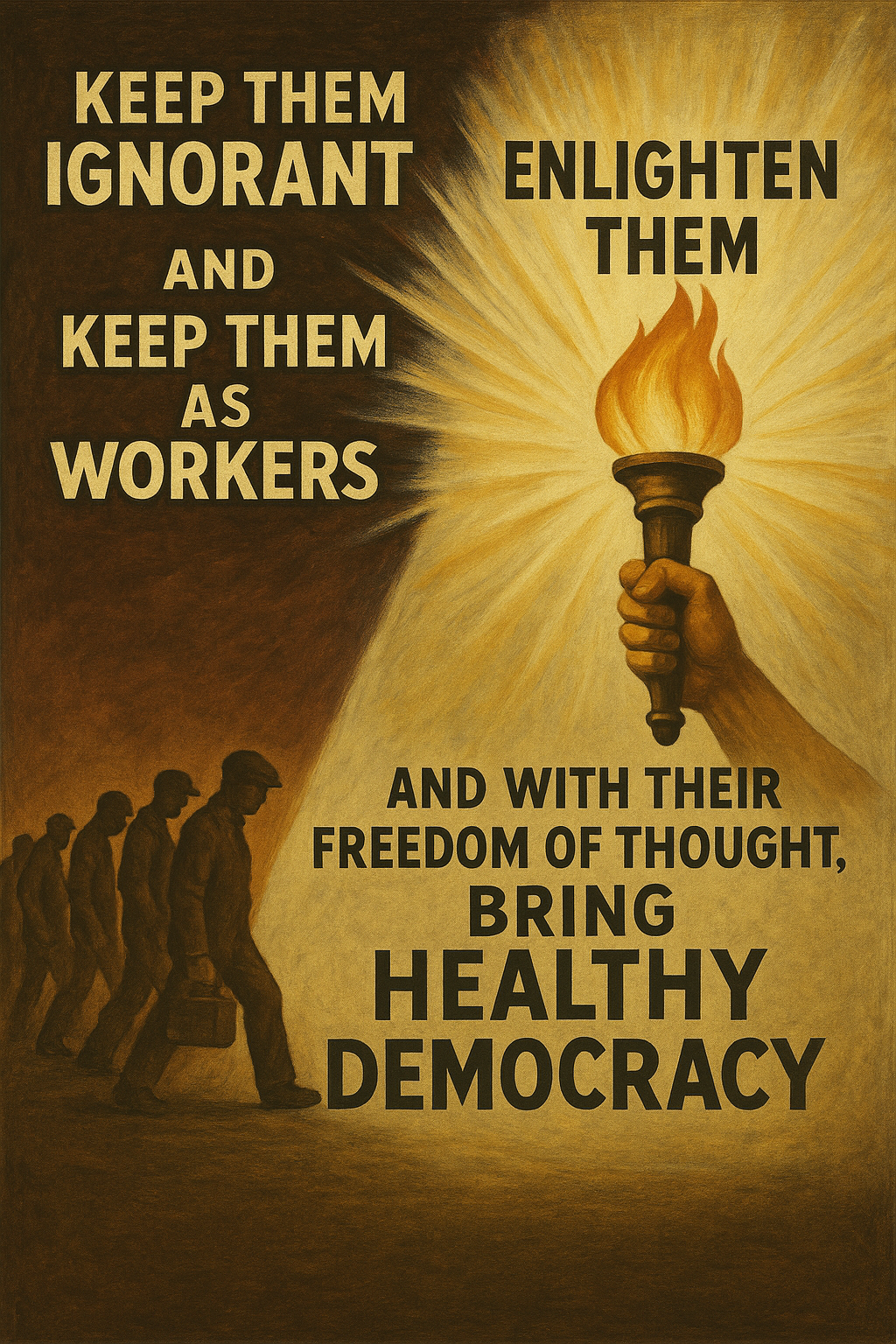
“If a nation expects to be ignorant and free, in a state of civilization, it expects what never was and never will be.” – Thomas Jefferson
“You don’t have to burn books to destroy a culture. Just get people to stop reading them.” – Ray Bradbury
“The illusion of freedom will continue as long as it’s profitable. When it’s no longer profitable, the illusion will be taken away, and you’ll see the brick wall at the back of the theatre.” – Frank Zappa
What Are We Really Teaching?
When we talk about “education,” we often mean curriculum, standardized tests, and professional training. But how often do we ask: • What kind of knowledge are we passing on? • Are we preparing students to think critically, adapt, and thrive in a changing world? • How are we measuring well-being, mental health, creativity, or civic engagement?
Scoring well on standardized tests does not necessarily mean students are flourishing or prepared for the future.
The Narrow Scope of Higher Education
Take a university engineering student as an example: • Will they learn about global politics, different cultures, climate change, or ethics? • Will they explore compassion, empathy, or citizenship?
Most often, no—unless by chance, through an inspiring professor or peer environment. Without exposure to the arts, humanities, politics, and philosophy, can we really expect graduates to make informed democratic decisions or contribute fully to society?
Why Broad Education Matters
A broad-based education—history, arts, religion, philosophy, politics, and culture—is not a luxury. It is a foundation for democracy. Without it: • Citizens lack the context to question systems of power. • Elections become about slogans and personalities, not policies. • Emotional manipulation replaces logic and debate.
This is not hypothetical—we already see it in populist rhetoric and simplistic political campaigns that appeal to fear rather than reason.
The Legacy of Control
Our modern education system was built in the 19th century to produce workers, not leaders. It fills “empty vessels” rather than fostering curiosity. Elite and private schools continue to provide advantages for the few, while the majority are trained to fit into existing systems rather than challenge them.
Historically, education has often reinforced power structures rather than disrupted them. From ancient China to modern democracies, elites have used education to maintain control, not broaden it. Only rarely do we see education used to truly empower citizens.
Canada’s Challenge
In Canada, students learn little about global politics, governance beyond Parliament, or non-European histories and cultures. Yet we live in a global economy. How can students become informed citizens without these perspectives?
Government control over curriculum, standardized testing, and even delivery methods means that pedagogy is shaped by political priorities—not necessarily by educators. Should elected officials without expertise in teaching decide what students learn?
The Consequences of Shallow Learning • Students graduate without financial literacy, civic knowledge, or even an understanding of their own health. • Critical thinking is underdeveloped, making people vulnerable to misinformation. • Opinions often form from single sources or trusted friends, reinforced by a fixed mindset and resistant to evidence.
International tests like PISA try to link test performance to economic growth, but results are inconsistent. Some emerging economies grow rapidly despite low PISA scores, showing that education quality must be assessed in broader ways, including creativity, well-being, and peer learning.
What Needs to Change
If education primarily trains workers, how do we nurture entrepreneurs, innovators, and democratic citizens? By deliberately broadening curriculum and assessment to include: • Civics and government (beyond one high school credit). • Financial literacy, taught by trained educators. • Arts, humanities, and global citizenship as central, not optional. • Well-being, empathy, and real-life knowledge integrated throughout.
Education should be continuous—not ending at graduation. Lifelong opportunities for formal learning can help sustain democratic societies.
A Warning from the U.S.
The U.S. shows the risks of an unequal, divided education system. Wide gaps in equity and opportunity are undermining democracy. Canada must not follow this path.
⸻
A Vision for Canada
We need a curriculum that is: • Equal: available to all Canadians, regardless of background. • Global: teaching world history, politics, and culture alongside Canadian content. • Holistic: valuing well-being, creativity, and the arts. • Forward-looking: preparing citizens for entrepreneurship, sustainability, and democratic leadership.
By doing so, we can nurture citizens who are not only workers, but also critical thinkers, innovators, and stewards of democracy.
I’ve been fortunate to spend some time with a dear friend Jim Wolfston from CollegeNET over the past few years. Jim is the founder of CollegeNET, an American Corporation heavily involved in social activism and developing tools to support higher education. He is a deep and brave thinker.
One of our latest conversations in light of the huge geo-political challenges the world is facing was centred around current challenges with President Donald Trump in the U.S. and the big question: how did we get here? Jim proposed something that was quite simple: the “me” generation(s).
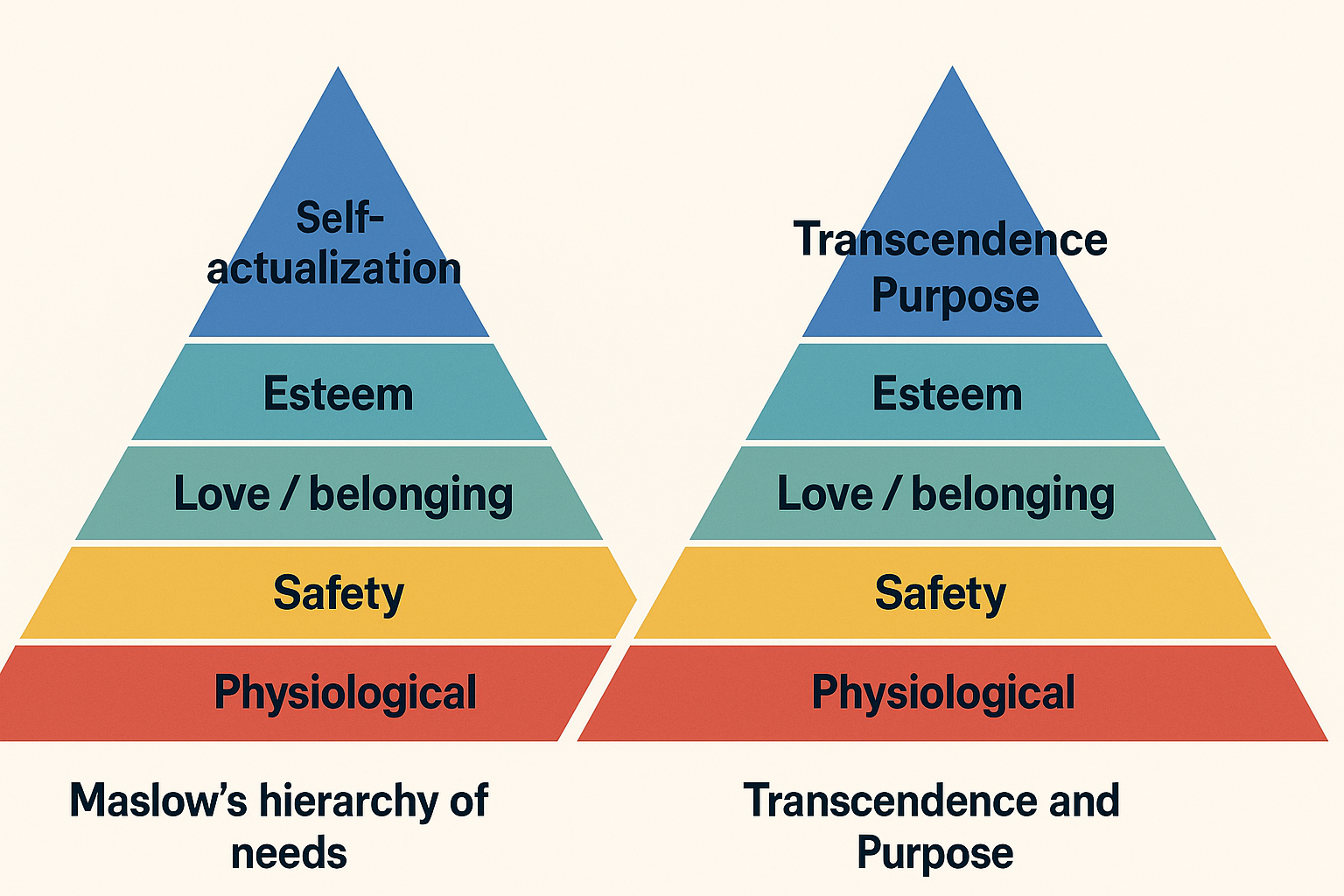
Interestingly, I happened to be reading a book by Victor J. Stretcher called “Life on Purpose”. In this book, Stretcher references Abraham Maslow’s Hierarchy of human needs. Maslow’s hierarchy is a pyramid of human needs beginning with basic safety, food, shelter and then moves up to “self-actualization” with a focus on “self-realization” and “self-fulfilment”
Stretcher writes: “This emphasis on an individual’s own actualization heralded the “me generation”-baby boomers intent on jogging, dieting, and meditating (or navel gazing, in the words of their detractors) to reach this “self-realization and self-fulfillment”.
Stretcher proposes that in the words of Viktor Frankl this “self-focus” was narcissistic and ultimately detrimental to the self.”
Stretcher continues:
“ Real fulfillment in life occurs only when a person transcends the self”.
Maslow changed his mind towards the end of his life about the “self-actualization”. Maslow wrote:
“The fully developed human being working under the best conditions tends to be motivated by values which transcend his self. They are not selfish anymore in the old sense of that term.”
Stretcher points out that Maslow then began to study “transcenders”. Maslow found that transcenders demonstrated “humility, a sense of ignorance, a feeling of smallness, awe before the tremendousness of the universe”. Stretcher points out that Maslow admitted that his original model was wrong.
Stretcher writes:
“These individuals were better able to see connections between disparate ideas, making them better innovators and discoveries.”
This shift from “self-actualization” now considers “purpose”. Purpose considers making contributions to the lives of others.
Jim Wolfston is right. The me generation has resulted in the erosion of interdependence, the caring about and for others. This focus on self and what “I can get” out of life has whittled away at the social safety net and promoted individual greed.
Let’s cultivate a new generation of “transcenders”. People with purposed that will help us solve humanity’s greatest crisis. We are at crossroads as a species. It’s time to work together and benefit “everyone” and not just the “one”.
I recently attended a conference in Berlin called “ClassicalNEXT” which tackled the issue of the future of classical music. It was very stimulating and filled with people from all over the globe. A real collective “think”.
I collaborated with a colleague from Finland hosting a roundtable discussion about innovation in music education including virtual tools and AI. Finland assesses music education and performance through peers more often than teachers.
As the world turns faster with the advancement of AI and its impact on everything, traditionalists have mixed reactions to this new tool and its implications. Some embrace it and see its potential for adding value to music and music education and others feel threatened by it and fear it will destroy traditions and steal ideas. One conclusion I heard from a presenter was that AI won’t take your job. People who know how to use AI will take your job. That was powerful and speaks to the task at hand: learn about it and how it might help you to be more efficient and get more ideas or….fall behind!
So what is the future of classical music in this new arena? One could ask about the relevance of all traditions in Arts and Humanities as AI dominates the conversation. I believe its future is strong and may be even stronger in the context of this new chapter in human development. The guidepost for these changes is always going to be about a moral compass. People can use technology for good and bad. We need to work hard to make sure that it is used for good. UNESCO has done a great job spelling out the ethical development of AI and I highly recommend visiting this resource. Here is a URL to that resource:
I ran a concert hall for over 20 years and have witnessed a lot concerning all of the music genres. From my perspective, there are a number of challenges to the future of classical music:
Music Education: start young and establish the normality and appreciation for it. If a child picks up a violin now, they will likely support an orchestra later. They also did “that” and it becomes normalized and not privileged.
Live music: get young people out to venues and establish a habit for going to them. Let them experience not only the music, but foster a sense of community and connectivity throughout the time they are there.
Elitism: provide opportunities for classical music to be performed throughout communities and make it affordable or free.
Musicians: don’t just show up and play and then disappear. Go out into the audiences whenever possible (before the concert, intermission and afterwards) and cultivate ongoing relationships with them. Talk about life, meaning and the music itself. Take the focus away from the performance outcome and focus on the emotions and intent, reactions and questions.
Technology and AI: Technology has been with classical music for quite some time now. With the introduction of every new possibility, there have been those that are in fear and look to the past, and those who get excited and look to the future. Cultivate curiosity and engage with innovation. Become masters of it and see what is useful. Lead the innovation and don’t let the industry around classical music be led by the industry of technology. Even offer to co-develop it.
Embrace fusion and innovation in music composition: Try to keep an open mind. Everything was new at some point and listeners either resisted or embraced the novelty.
Interpretation: as Chick Corea once said to me: “Classical Musicians take themselves too seriously”. Is it a bad performance if the ornament comes before the beat or on it? Was the tempo unorthodox? Was the articulation out of “style”. Does any of this really matter? Is someone going to die from this? Is quality going to suffer if someone doesn’t get it right? We get so wound up with the “truth” that we forget the creativity and experiential part of music making. Cut some slack and listen to different perspectives; highly schooled or not. Foster music making and perspectives. It will make the art former richer!
Attention spans: as we know, they are limited for many these days. Talk about the pieces you are playing and guide the listener. Don’t make it a “lecture” recital, but an open dialogue for preface and reaction. Don’t be afraid to have a conversation with your audience.
Formality: let them clap where they like. Get used to it. Jazz musicians did and do. Lots can happen in a theatre. Young people can make noises at inappropriate times, someone could cough or sneeze, someone might need to get up at an inappropriate time and leave. Don’t glare and make them feel unwelcome. Try to find ways to foster a collaborative audience experience that includes real humans together and not the unrealistic expectations of silence. I’m sure everyone has their disruptive moment during a performance!
The Genre: Classical Music is just music. It’s not until society tells the uninitiated that it is something else that it gets its elitist reputation. I ran a free afterschool music program “El Sistema Aeolian” for 14 years. We once took the kids to perform and interact with a budding group of Elementary Teachers at Teachers College, Western University. One of the teachers in training asked: what do you do with the prejudice against classical music. I responded: “Thanks a lot; they haven’t learned that yet!”
Recordings versus Live: one isn’t better than the other. If a listener enjoys listening to recordings, it isn’t wrong. You shouldn’t tell them they are missing something. Invite them to a live concert and let them make up their own minds about the ways they want to enjoy music.
Advocacy: there is growing research to show that the study of music and especially classical music helps with cognition and develops many skills that benefit people throughout their lives.. It’s not the authentic reason to study music, but a side benefit. Learning and playing classical music is about the joy factor!
These are a few ideas I have about the future of classical music. I would love to hear your perspective; traditionalist or not!