Clark Bryan is an award-winning concert pianist and recording artist. He has studied with some of the greatest pianists of our times. With more than a dozen albums to his credit, Clark has also recorded over two thousand piano works since the Pandemic. As a teacher, Bryan has taught thousands of students, adjudicated more than 75 music festivals coast-to-coast in Canada, given dozens of workshops and written a book, “Gateways to Learning and Memory”.
In 2004, he founded The Aeolian Performing Arts Centre. Today, this historic and legendary Centre is recognized as a beacon for arts and culture in Ontario and regularly hosts musical artists of many genres and is prized for the gift of intimacy and acoustics it provides to both audiences and performers.
Bryan believes that everyone should have universal access to music, art, education, and culture. Because of this belief, he launched El Sistema Aeolian in 2011. This free, UNESCO award-winning program has offered more than a thousand children and youth an opportunity to experience the joy of a rich musical education. “Music is one of the most powerful tools we have for social change,” he says. In all his work with the arts and education work, Clark displays a progressive, social-justice mindset.
Other innovations have included Aeolian Pride Choruses, Rebelheart Collective, Aeolian Talks, A National Song Writing Competition and The Aeolian Jazz and Musical Arts Festival.
Bryan was awarded Musical Personality of the Year (2005) and won a Jack Richardson Award for Community Contribution (2011). In 2017, Mr. Bryan was given the Western Alumni Award of Merit and inducted into the Don Wright Faculty of Music Wall of Fame. In 2018, Clark was recognized with a Canada 150 Award through the House of Commons for his contributions to community and the nation. In 2022, Clark won Best Classical Solo Musician at Forest City London Music Awards. In 2023, Bryan was featured in a book about London by renowned author Richard Bain. In 2023, Clark was awarded a Lifetime achievement award from the Forest City London Music Awards and inducted into the London Music Hall of Fame. In 2024, he was awarded The Mayor’s Honour List from The City of London.
Bryan continues to extend his reach into the community. Whether speaking about the power and joy of music study in his TEDX talk or engaging in community activism, Clark is committed to community. He speaks regularly at events, is featured on radio, newsprint and television.
July 2, 2015
William Deresiewicz recently published a book entitiled “Excellent Sheep”. Besides outlining the failings of our educational approach in our elite systems, he focuses on “the meaningful life”. I love his last quote of Thomas Hardy:
“The beggarly question of parentage-what is it, after all? What does it matter, when you come to think about it, whether a child is yours by blood or not? All the little ones of our time are collectively the children of us adults of the time, and entitled to our general care.”
If we can treat every child with this fairness and equity-not to mention love, we can change the world!
July 2, 2015
I recently wrote this article for El Sistema Toronto’s e-newsletter:
Building Self
El Sistema is both a social movement and an inspiring music education program. The social component is about community building and eliminating barriers to participation, but is that enough? The music education component is an enriched intensive experience for our participants, but are we just offering a conditioned traditional approach?
Education in its best form is a shared experience. It should be an atmosphere of discovery. Our students are not empty vessels needing to be filled. They are also our teachers. It’s not just our participants who can learn and grow as we teach young people, but also our teachers, administrators, volunteers, families and communities.
The positive psychology movement is casting a revolutionary framework we can use for the social/educational context of El Sistema. Seligman, one of the leaders of this movement has proposed five foundations of human needs which give us a comprehensive sense of well-being. They are: Positive Emotions, Engagement, Relationships, Meaning and Accomplishments. If we make this model the foundation of our social/education framework we can then create tools to nurture these five areas of personal and social development.
These tools and approaches will help us continue to develop our revolutionary programs and create more influence for better education approaches and social impact.
May 6, 2015
Norman Doidge in his book “The Brain That Changes Itself” has offered us an incredible gift. It is the beginning of the instruction book for the human brain. Although research into neuroplasticity is still in its infancy, Doidge stands at the gateway of ushering in a new era of understanding of both how the brain works and how we can change the way it works. A couple of quotes I really enjoyed:
“So a neuroplstically informed view of culture and the brain implies a two-way street: the brain and genetics produce culture, but culture also shapes the brain. Sometimes these changes can be dramatic.”
“Studies by Taub and others of musicians who play stringed instruments have shown that the more these musicians practice, the larger the brain maps for their active left hands become, and the neurons and maps that respond to string timbres increase….Brain imaging shows that musicians have several areas of their brains-the motor cortex and the cerebellum, among other-that differ from those of non musicians. Imaging also shows that musicians who begin playing before the age of seven have larger brain areas connecting the two hemispheres.”
April 22, 2015
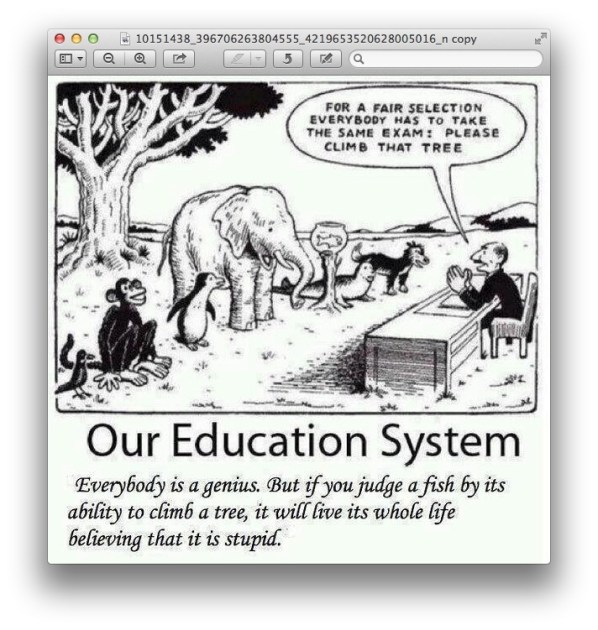
This sums up my feelings and experiences with our current approach to teaching and learning from our Education Systems in Canada and much of the world.
April 21, 2015
I stumbled across a TED talk that got me thinking about how much we need to do in regards to learning and teaching opportunities. I had considered Steiner/Waldorf models of outdoor gardens and outdoor teaching, but hadn’t given thought to the shape, size and design of schools. This kindergarden school in Japan bursts the four-wall model we have all become familiar with. It nurtures activity, fitness, community, nature, play and fun! A circular environment brings children back to learning and follows their “play activities” running in circles. Tree climbing and exploration are also natural to children and can be found throughout this amazing facility. The designer makes the case for children taking risks, falling down and hurting themselves as a natural and good phenomenon!
http://www.ted.com/talks/takaharu_tezuka_the_best_kindergarten_you_ve_ever_seen
March 28, 2015
Last weekend, The Aeolian and The Ontario Registered Music Teachers Assocation ran a weekend of concerts and pedagogy presentations. André Laplante and Sara Davis Buechner gave stunning performances with a vast array of repertoire. The presentations focused on bringing back an “authentic” focus for music making in a community context. André spoke about his early studies and the horrors of his early experiences with teachers trying to live vicariously through him. I gave a presentation on Emotional Intelligence and building a conscious focus of teaching “EQ” to our students. D&S Pianos presented the latest technology of “hybrid pianos” which are transforming the ability to practise creatively and do so in apartments and condos. Joel Faflak from the “Advanced Studies in Arts and Humanities” from Western University talked about fear, failure and making space for the creative process. He asked the question “Are we too busy doing and not taking enough time to waste time and get ready to create?”. Sara gave practical presentation on piano technique where she focused on methods from the past. We concluded with a stunning presentation by David Visentin from El Sistema Toronto. He asked the question “Are we living up to the promise of social outcomes in our teaching?”.
Although there were thematic links to many of the presentations, there were also contridictory ideas. I was happy with this! It is in this tension of contradictions that we become creative!
March 16, 2015
We are now beginning to connect with higher purpose, looking for “happiness” or “wellbeing”. Seligman defines wellbeing as embracing the following five footprints:
- Positive Emotions
- Engagement with life
- Relationships; positive ones
- Meaning; a sense of purpose or beliefs
- Accomplishment: we feel good when we accomplish something
With this new emerging awareness of “who” we are, the types of jobs and education systems we have had don’t make sense. They aren’t valid or relevant anymore. Perhaps one could say that their validity is fading away. There are still some jobs which require “widget making” or clerical “pencil pushing”, but these are diminishing. Along with these diminishing jobs are their false sense of security and predictability. After all, there has never been anything secure in life except the knowledge that there is going to be an exit point!
March 10, 2013
“I won’t come if you have cabaret-style seating”. How many times have I hear this from professors and others entrenched in the formalities of the classical music culture. At Aeolian Hall, we’ve tried to make changes in how people engage with classical music. Cabaret-style seating, food and drinks at your seat and more interaction with the performers throughout the program are offered to give a less “formalized” atmosphere. Socialization is encouraged at intermission and after the concert to discuss the performance or whatever else brings joy to meeting in community. We’ve even run a “Classical-Jazz” series where classical music is paired with jazz-not fused. These changes are met by enthusiam by most, but there is still a group of people who cling to tradition. In my opinion, these are the same people who are preventing new audiences from engaging in classical music. Many of these people believe that we must keep a “wall” up between classical music and other forms. They fear that classical music will get “contaminated” if we don’t keep this wall up. The greatest musicians I have met believe otherwise.
Every day I contemplate the revolution which needs to happen in our society. At the foundation of this revolution is a completely different education system, one based on Seligman’s PERMA:
Positive Emotions
Engagement
Relationships
Meaning
Acheivement
These five pillars nuture “well-being” in all of us. If we can find ways in whatever we teach to implement this PERMA foundation, we will have the kind of citizen we need to change the world. Why change the world? Well, it’s getting warmer….
Please read Seligman’s “Flouish” and see if you can find ways to build well-being in your own life and those around you. Advocate for the change in education we need to ‘save this world”.
February 23, 2015
Emotional Intelligence is one of many human capacities we can train and develop. Researchers are discovering that high Emotional Intelligence (EQ) has a profound effect on business success, employee satisfaction, income levels and helps the individual flouish in life.
Can we find ways to incorporate the training of emotional intelligence in our teaching and learning. What about leadership? Here’s an example related to music:
Music students often have to practise technique (scales, chords etc). What if we introduced emotional states (known or unknown to the participant) and got them to play that scale “angry” or “red”? What about “blue” or “sad”? Can we introduce more vocabulary for emotional states (high, medium and low states) such as “elated” or melancholy to young people? Increasing the understanding of the states and the vocabulary can help us improve both internal EQ and better read external EQ.
Let’s all think about the many and varied ways we can learn more about EQ and nurture and develop it within ourselves and others. Let’s proactively add EQ education into the many daily activities we do and the learning environments we have. The end result will be a a citizen equiped for our rapidly changing world and one who can enjoy all of the subtlties of self-development and community interaction.
 Clark Bryan