“If a nation expects to be ignorant and free, in a state of civilization, it expects what never was and never will be.” – Thomas Jefferson

“You don’t have to burn books to destroy a culture. Just get people to stop reading them.” – Ray Bradbury

“The illusion of freedom will continue as long as it’s profitable. When it’s no longer profitable, the illusion will be taken away, and you’ll see the brick wall at the back of the theatre.” – Frank Zappa


What Are We Really Teaching?

When we talk about “education,” we often mean curriculum, standardized tests, and professional training. But how often do we ask:
• What kind of knowledge are we passing on?
• Are we preparing students to think critically, adapt, and thrive in a changing world?
• How are we measuring well-being, mental health, creativity, or civic engagement?

Scoring well on standardized tests does not necessarily mean students are flourishing or prepared for the future.


The Narrow Scope of Higher Education

Take a university engineering student as an example:
• Will they learn about global politics, different cultures, climate change, or ethics?
• Will they explore compassion, empathy, or citizenship?

Most often, no—unless by chance, through an inspiring professor or peer environment. Without exposure to the arts, humanities, politics, and philosophy, can we really expect graduates to make informed democratic decisions or contribute fully to society?


Why Broad Education Matters

A broad-based education—history, arts, religion, philosophy, politics, and culture—is not a luxury. It is a foundation for democracy. Without it:
• Citizens lack the context to question systems of power.
• Elections become about slogans and personalities, not policies.
• Emotional manipulation replaces logic and debate.

This is not hypothetical—we already see it in populist rhetoric and simplistic political campaigns that appeal to fear rather than reason.


The Legacy of Control

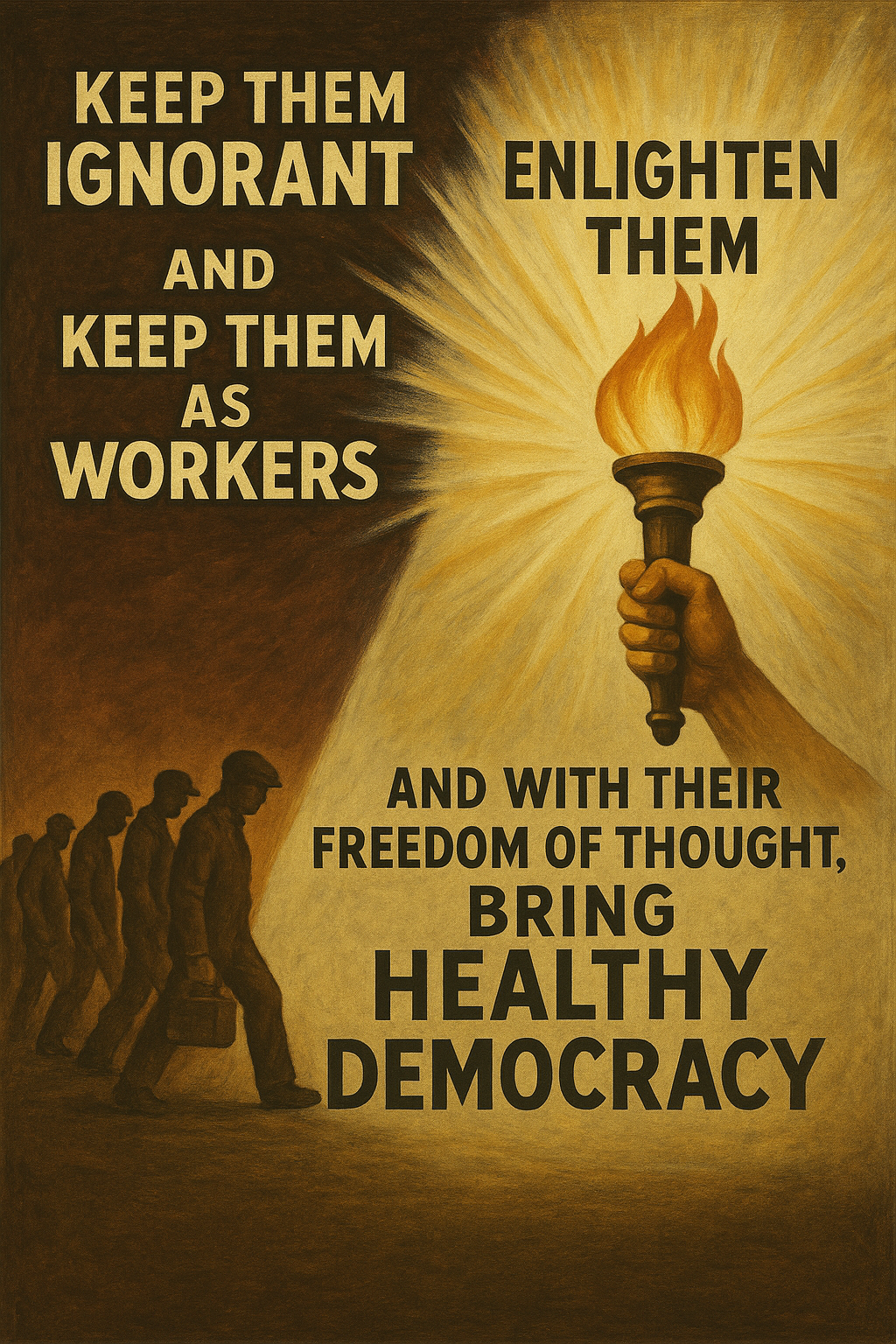
Our modern education system was built in the 19th century to produce workers, not leaders. It fills “empty vessels” rather than fostering curiosity. Elite and private schools continue to provide advantages for the few, while the majority are trained to fit into existing systems rather than challenge them.

Historically, education has often reinforced power structures rather than disrupted them. From ancient China to modern democracies, elites have used education to maintain control, not broaden it. Only rarely do we see education used to truly empower citizens.


Canada’s Challenge

In Canada, students learn little about global politics, governance beyond Parliament, or non-European histories and cultures. Yet we live in a global economy. How can students become informed citizens without these perspectives?

Government control over curriculum, standardized testing, and even delivery methods means that pedagogy is shaped by political priorities—not necessarily by educators. Should elected officials without expertise in teaching decide what students learn?


The Consequences of Shallow Learning
• Students graduate without financial literacy, civic knowledge, or even an understanding of their own health.
• Critical thinking is underdeveloped, making people vulnerable to misinformation.
• Opinions often form from single sources or trusted friends, reinforced by a fixed mindset and resistant to evidence.

International tests like PISA try to link test performance to economic growth, but results are inconsistent. Some emerging economies grow rapidly despite low PISA scores, showing that education quality must be assessed in broader ways, including creativity, well-being, and peer learning.


What Needs to Change

If education primarily trains workers, how do we nurture entrepreneurs, innovators, and democratic citizens? By deliberately broadening curriculum and assessment to include:
• Civics and government (beyond one high school credit).
• Financial literacy, taught by trained educators.
• Arts, humanities, and global citizenship as central, not optional.
• Well-being, empathy, and real-life knowledge integrated throughout.

Education should be continuous—not ending at graduation. Lifelong opportunities for formal learning can help sustain democratic societies.


A Warning from the U.S.

The U.S. shows the risks of an unequal, divided education system. Wide gaps in equity and opportunity are undermining democracy. Canada must not follow this path.


A Vision for Canada

We need a curriculum that is:
• Equal: available to all Canadians, regardless of background.
• Global: teaching world history, politics, and culture alongside Canadian content.
• Holistic: valuing well-being, creativity, and the arts.
• Forward-looking: preparing citizens for entrepreneurship, sustainability, and democratic leadership.

By doing so, we can nurture citizens who are not only workers, but also critical thinkers, innovators, and stewards of democracy.

I recently attended a conference in Berlin called “ClassicalNEXT” which tackled the issue of the future of classical music. It was very stimulating and filled with people from all over the globe. A real collective “think”.

I collaborated with a colleague from Finland hosting a roundtable discussion about innovation in music education including virtual tools and AI. Finland assesses music education and performance through peers more often than teachers.

As the world turns faster with the advancement of AI and its impact on everything, traditionalists have mixed reactions to this new tool and its implications. Some embrace it and see its potential for adding value to music and music education and others feel threatened by it and fear it will destroy traditions and steal ideas. One conclusion I heard from a presenter was that AI won’t take your job. People who know how to use AI will take your job. That was powerful and speaks to the task at hand: learn about it and how it might help you to be more efficient and get more ideas or….fall behind!

So what is the future of classical music in this new arena? One could ask about the relevance of all traditions in Arts and Humanities as AI dominates the conversation. I believe its future is strong and may be even stronger in the context of this new chapter in human development. The guidepost for these changes is always going to be about a moral compass. People can use technology for good and bad. We need to work hard to make sure that it is used for good. UNESCO has done a great job spelling out the ethical development of AI and I highly recommend visiting this resource. Here is a URL to that resource:

https://www.unesco.org/en/artificial-intelligence/recommendation-ethics

I ran a concert hall for over 20 years and have witnessed a lot concerning all of the music genres. From my perspective, there are a number of challenges to the future of classical music:

  1. Music Education: start young and establish the normality and appreciation for it. If a child picks up a violin now, they will likely support an orchestra later. They also did “that” and it becomes normalized and not privileged.
  2. Live music: get young people out to venues and establish a habit for going to them. Let them experience not only the music, but foster a sense of community and connectivity throughout the time they are there.
  3. Elitism: provide opportunities for classical music to be performed throughout communities and make it affordable or free.
  4. Musicians: don’t just show up and play and then disappear. Go out into the audiences whenever possible (before the concert, intermission and afterwards) and cultivate ongoing relationships with them. Talk about life, meaning and the music itself. Take the focus away from the performance outcome and focus on the emotions and intent, reactions and questions.
  5. Technology and AI: Technology has been with classical music for quite some time now. With the introduction of every new possibility, there have been those that are in fear and look to the past, and those who get excited and look to the future. Cultivate curiosity and engage with innovation. Become masters of it and see what is useful. Lead the innovation and don’t let the industry around classical music be led by the industry of technology. Even offer to co-develop it.
  6. Embrace fusion and innovation in music composition: Try to keep an open mind. Everything was new at some point and listeners either resisted or embraced the novelty.
  7. Interpretation: as Chick Corea once said to me: “Classical Musicians take themselves too seriously”. Is it a bad performance if the ornament comes before the beat or on it? Was the tempo unorthodox? Was the articulation out of “style”. Does any of this really matter? Is someone going to die from this? Is quality going to suffer if someone doesn’t get it right? We get so wound up with the “truth” that we forget the creativity and experiential part of music making. Cut some slack and listen to different perspectives; highly schooled or not. Foster music making and perspectives. It will make the art former richer!
  8. Attention spans: as we know, they are limited for many these days. Talk about the pieces you are playing and guide the listener. Don’t make it a “lecture” recital, but an open dialogue for preface and reaction. Don’t be afraid to have a conversation with your audience.
  9. Formality: let them clap where they like. Get used to it. Jazz musicians did and do. Lots can happen in a theatre. Young people can make noises at inappropriate times, someone could cough or sneeze, someone might need to get up at an inappropriate time and leave. Don’t glare and make them feel unwelcome. Try to find ways to foster a collaborative audience experience that includes real humans together and not the unrealistic expectations of silence. I’m sure everyone has their disruptive moment during a performance!
  10. The Genre: Classical Music is just music. It’s not until society tells the uninitiated that it is something else that it gets its elitist reputation. I ran a free afterschool music program “El Sistema Aeolian” for 14 years. We once took the kids to perform and interact with a budding group of Elementary Teachers at Teachers College, Western University. One of the teachers in training asked: what do you do with the prejudice against classical music. I responded: “Thanks a lot; they haven’t learned that yet!”
  11. Recordings versus Live: one isn’t better than the other. If a listener enjoys listening to recordings, it isn’t wrong. You shouldn’t tell them they are missing something. Invite them to a live concert and let them make up their own minds about the ways they want to enjoy music.
  12. Advocacy: there is growing research to show that the study of music and especially classical music helps with cognition and develops many skills that benefit people throughout their lives.. It’s not the authentic reason to study music, but a side benefit. Learning and playing classical music is about the joy factor!

These are a few ideas I have about the future of classical music. I would love to hear your perspective; traditionalist or not!

Many Canadians are waking up to the reality of having our values threatened. The United States President Donald Trump has expressed his desire to make Canada the 51st state of his country. It’s more important than ever that we define ourselves and our strengths so that we can fight against this geopolitical tyranny.

We talk about Canadian values, but does anyone spell them out? We could really use a moral compass right now and some leadership to remind us of that direction!

Here’s an attempt at spelling out Canadian values from my own personal perspective, but also from a lot of research:

Multiculturalism: This policy was adopted in 1971, celebrating diverse cultures. Canada was the First Nation to adopt this policy.

Gender Equality: Equal pay and rights protections along with legal and social activism towards equity.

2SLGBTQ+AI Rights: Broad protections for the Queer community culminating in same-sex marriage in 2005. We were among the first countries to legalize!

Our Constitution Emphasizes:

Social Welfare and collective responsibility

Cooperative Governance: between parties and levels of Federal, Municipal and Provincial Government

Stability of the rule of law: respect for the rule of law

The Canadian Charter of Human Rights came into being in 1982, giving us civil liberties such as freedom of expression, religion and assembly

Policies to protect natural resources, sustainability and mitigate climate change

Canada is officially Bilingual

Canada is working towards reconciliation with its Indigenous peoples including land rights, languages and cultural heritage

Canada’s social safety net is an expression of fairness, equity and community caring
This includes education, public healthcare, Canada pension plan and much more

Canada has a strong democratic tradition based on strong institutions, free elections and the cultivation of civil society.

Most Canadians believe in looking after each other. We aren’t perfect and have some really challenging social issues right now.

Whereas the U.S. emphasizes individual freedom, self-determination and personal responsibility, Canada emphasizes collective well-being, social harmony and responsible governance.

Canada has a policy of multiculturalism and encourages cultural retention alongside integration, whereas the
U.S. is a melting pot model for assimilation into a unified American identity. Canada celebrates diversity in official institutions whereas the U.S. often debates diversity politically.

Canada has a universal public healthcare and strong social welfare programs, whereas the U.S. has limited supports preferring to focus on charity or private initiative.

Canada has strict gun control laws, regulated and limited, whereas the U.S. see guns as a symbol of freedom and self-reliance.

Canada views itself as a peacekeeping cooperative nation with an identity shaped by moderation, diplomacy and tolerance, whereas the U.S. is shaped by independence, exceptionalism and ambition.

Canada is more secular in public life and government policy, whereas the U.S. has strong influence by religious groups on social issues and elections.

It’s important that we work to clarify, teach and really own these values that have evolved in our great country. We must fight to protect them and ensure we continue to work towards a more inclusive, diverse and equitable society.

Throughout history, opportunities for great education have been limited to the few. Public education was put into place in large part to feed commerce. It has served to prepare workers for the workforce. The workforce was needed to create things for companies owned by the elite, wealthy and powerful people in our societies. Those from wealthy families could afford to send their children to elite schools and have them graduate to positions of power in both industry and politics. Having wealth was often the ticket to both higher education and power. As demonstrated in recent times, students from wealthy families have paid extra money to institutions of higher education in order to guarantee entrance for their children to those institutions. Not only can this wealth guarantee entrance to these institutions, but it can also guarantee the marks needed for graduation.

How are we doing in Canada? Are all schools equal and access equitable? Let’s start with elementary schools and high schools.

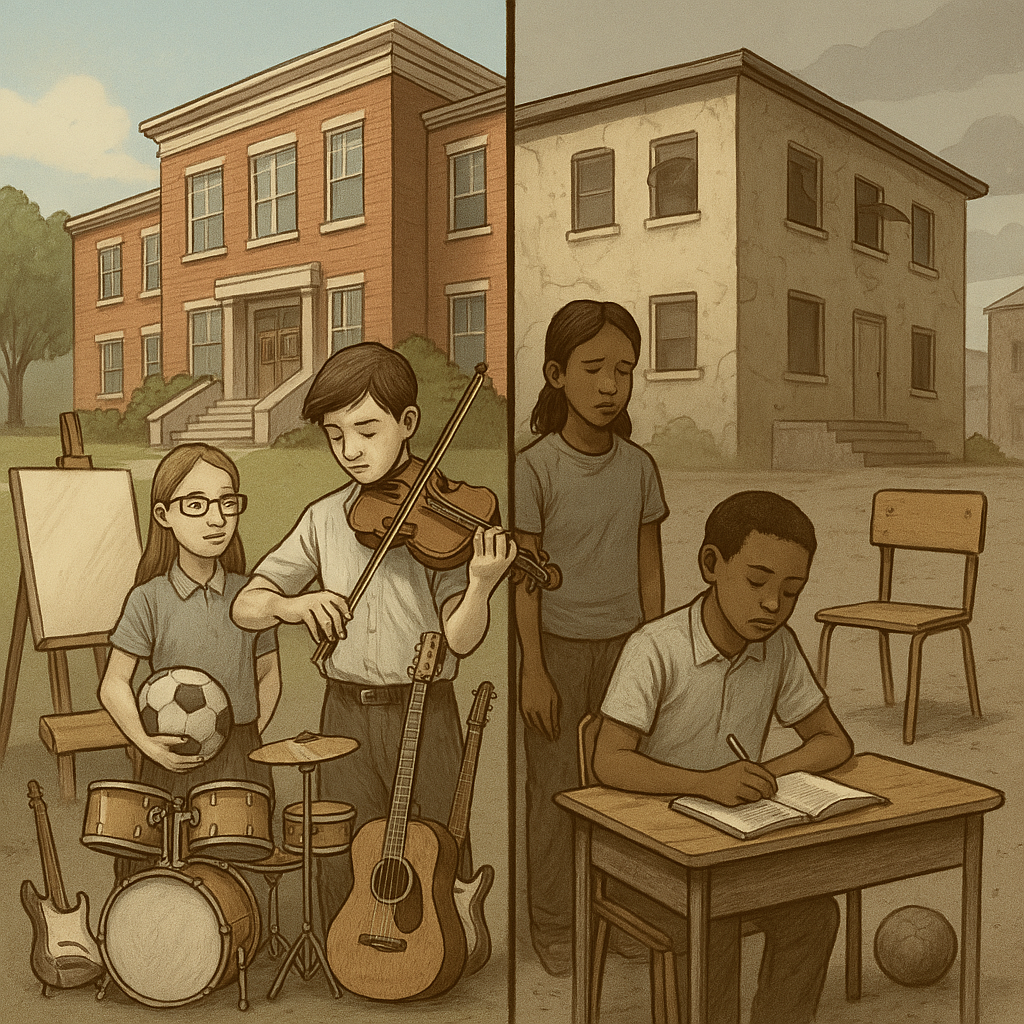
There are a growing number of schools that are marginalized by social-economic classes. These are the schools that don’t have parents who can fundraise for school trips or extra school equipment. These are the schools that don’t have enriched arts programs and have few if any afterschool extra-curricular activities. In Ontario, it’s up to the Principal of the school as to whether or not there are arts programs! No equity at all!!

Although the curriculum for all provinces in Canada includes the arts, if there is no arts specialist (such as music specialist) on staff, its up to the individual teacher how they will manage or not manage to teach music. In countries like Finland, Arts education is considered a human right and there are specialists in each school as well as 97 publicly funded music schools for an afterschool education opportunity. Of course there is also music in their public schools….each and every one. Teachers in Finland must have at least a Masters Degree to teach and it is a highly competitive profession where only about 10% of those who apply get the opportunity to teach. Music and Arts specialists exist in every school there.

Scientists at Standford and education specialists around the world have clearly stated that our future will rely on creative entrepreneurs. They will create the new economy and tackle our social and environmental challenges. Daniel Pink in his book “A Whole New Mind” makes creative education his thesis and the basis for his arguments about the type of economy that’s ahead of mankind. Manufacturing jobs will become scarce as automation and AI take over. Entrepreneurs who have been steeped in creative risk-taking and the skills needed will form a new economy based on invention.

Creativity comes in large part from the arts and not as much from STEM education. This is a supporting reason to include the arts as an essential part of our education curriculum and make that education happen! The fundamental reason for the inclusion of the arts in core curriculum is that it is equitable and good for us. It brings joy and fulfillment to our lives. Kids are often motivated to get out of bed and go to school for arts curriculum… more often than STEM curriculum.

Knowing that some families and children have access to an enriched education and other don’t, how do parents feel about this? The working class might not even notice as they are busy trying to hold their lives together. But when they do, I’m sure outrage and action is ahead. The United States is a great example of this. There are huge social-economic divides in the U.S. and there is a rising “us and them” political and cultural civil war happening as a result. Education equity is a huge factor creating this divide. This is not good for society or the economy. Let’s not let Canada slip further away, but act with awareness to ensure that we fight for equitable education for all Canadians! How? Start conversations about it. Talk to your teachers, school boards, family and governments and insist that what we are doing does not align with Canadian values. Protest and vote for the change. Change comes when you drag the politicians into it!

I was speaking with a Finnish colleague recently about the relevance of what we both do for music and music education in the context of the current political and social turmoil. After some reflection, I thought I would write some thoughts on this subject: I’ve spent so much of my life journey as a musician and educator.

For fourteen years, I ran El Sistema Aeolian: a free, intensive afterschool music program I founded in 2011. The program is still running after my retirement and serves a community of youth and their families from diverse backgrounds. The majority of participants are either newcomers to our country or first generation. This group has two prevalent barriers to participation in regular paid programs: economic scarcity and lack of social fluency/social mobility. To be clear: they didn’t have money and they didn’t know many (or and in some cases any) people who could help them gain social wealth. This social wealth is the contacts they have that could help them succeed in the new Canadian Culture.

Recognizing the barriers to participation, I began to construct a social curriculum for this program. This curriculum included leadership, peer mentorship, social/emotional intelligence, self-awareness, self-actualization, well-being and much more. I ran a weekly leadership class that included regular visits from politicians, activists, clergy, non-profit leaders, business owners, artists, musicians and others. The goal of the leadership class was to increase the ability of participants to see the world more broadly and help them find their place in it. All this through the inspiration of music.

We took the participants on expeditions to perform in places like the University, Homless Shelters, Police Stations, City Hall and others. Through these experiences, the participants were exposed to people who treated them with appreciation and respect. The participants not only knew where the University was, but they had met people who were kind and respectful towards them. This gave many kids the idea that they might see themselves there someday. In some cases, family histories had no relatives that had ever attended a post-secondary institution. Over the years, I witnessed and assisted many participants into their post-secondary journeys into Universities and Colleges.

This is just one example of how the arts can transform people’s lives. We need to embrace the value of an arts education during these turbulent times as a steadying factor of optimism and self-development. Not only are the arts important, they are crucial to finding ways to help us all thrive in society. Let all artists and art educators remember this! Let the general public be aware and learn to see the arts as vital and life changing.

We are a long way from having any sort of education equity in our country. I’m optimistic that we can achieve equity once our people understand that it doesn’t exist now and understand the benefits of education equity. Having under educated people creates a society of “us and them”. It leads to social unrest and populism. It is the root of a diseased society.

Leaders would tell you that the inequality has to do with lack of funding, but why are the good educational opportunities most often present for the middle class and up? That is because they have the political power. End of story. They are the doctors, teachers, lawyers, architects, engineers and so many other professional positions in our society. They shape the system. They often believe that if someone is to succeed financially in life, others have to be subservient to them. They believe we should keep the lower classes lower.

We’ll fix that! I’m optimitic. It’s the soft revolution that will make a huge difference for all of us.

But once everyone gets access to the same education content, is the same education content serving us well?
Most education content is designed to exercise short term memory challenges. Learning for the test and quiz is critical for success, but it is short-lived. Hundreds of students have told me that they don’t see the point of this type of schooling. They forget most everything after the test or examination.

With AI finding information for us in seconds, why do we need to retain facts? Or better still, what facts do we need to retain and what skills do we need to develop? This is the question we need to ask. Some are. The problem is our education system is extremely bureaucratic and run by governments who often have no expertise. It responds extremely slowly to change. Change is now happening at lightning speed!

Besides the skills and knowledge we need to attain for success in our society, what experiences, skills and knowledge do we need to flourish as human beings? How do we build ourselves into strong, brave, resilient individuals with the necessary grit to face life’s challenges?

What could we be teaching consistently from the beginning? Not just one elective class in high school, but classes each year that teach:

Money/Finance class: not just one class, but classes each year starting from the beginning!
Earth class: empowerment and understanding to make our earth healthy again
Creativity Class
Teaching, Learning and Mentoring/Apprenticeship class: right from the very beginning, learning how
Critical Thinking class: not as part of something else, but how critical thinking works; every year of education
World Cultures Class: this includes a knowledge of world religions: every year of schooling and not elective
Great thinkers’ class: philosophy as a foundation for how to think and how cultures are formed
Role Models Class: investigating outstanding human beings and how they’ve lived their lives
Student driven subject class: put the learner in the driver’s seat
Values and Ethics class: sorely needed in our world today. We must teach good values, ethics and morals
The no curriculum class: a class where students shape the education they want
The unlearn class; this is where we question what we’ve learned: is it true? Is it valuable? Has it made me a better person?
The social justice class: a cause driven class
Leadership class: how to lead in any role and how to support leadership
How to get things done class: time management, goals, habits
Invention class: creating new things: this is extremely relevant with the problems our society is facing right now
Problem solving class: project based learning. Not just math, but real human challenges facing everyone
The Art of Being Class: what does it mean to be a human being?
How to build “self” class: the people we hang out with, the books we read, the music we play and more
Mortality class:  or perhaps:  Life Span Class: what is death? Yes, let’s talk about that
Beliefs Class: what do you believe? Why is it important?
Food Class: where does food come from, preparing it, sitting and having a meal together
Survival Class: grit and resilience to conquer or walk around life’s problems
The Great Teachers Class: who are the great masters? What wisdom did they leave us?
Performance and conquering fear class
Personal Development Class
Peace Class
Quiet Class (Meditation, Mindfulness etc.)
History: there is a huge focus on national history, but little else. How about that has repeated itself class?
Self-care class: How to look after my body class: understanding physiology
Sexuality class (every year of schooling)
Human behavior class: psychology
The class on what we don’t know.
The class on building a social movement: empowering the people
The class on global policy and politics
The class on diversity, equity and inclusion
The class on reconciliation: what does it mean? How can it be part of every day living?
Outdoor nature class
Personal Finance Class including investing
The doing nothing class:  naps, meditation, wasting time, sleep, unprogrammed time, how to observe and be present: The mandala class: The doodling class
The collaboration class: How to collaborate
The walking class (walks help the brain to think, notice, be creative, practice meditation, help the brain process ideas and much more). This would also include expedition learning outside of the classroom (what do we have to sit at desks to learn?

These are just a few ideas to spur some thought about things other than math scores and literacy. The arts are critical to our development personally and our development as a society. They need to be in every school “deluxe”. That means classes in dance, visual arts, theatre, music, and much more. Every year for every child!

Let’s work together to incubate a new education experience. One that liberates young people to be their best selves and at the same time, benefit society.

I had the great privilege of being invited to California State University at San Marcos to co-present a poster session on a new virtual classroom my friend Jim Wolfston at CollegeNET has created.

I was really hesitant to travel to the U.S.A. with the social unrest, political turmoil and Canada’s backlash against proposed tariffs the U.S. is planning for our country.

I’m glad I went! Social Mobility is the movement to help individuals and families to move up from stressful backgrounds of economic and social poverty to better lives. Its focus is on educational opportunities as a means to gather wealth; particularly University and College education. The gaps between those with wealth and those without are widening. This is not good for societies as it can lead to social unrest or opportunistic social engineering by those who gain power for personal wealth and control. These are the times we are living in!

While the conference was happening, protests could be heard outside of the facility on campus. I was actually escorted into the building with staff and police. The protests were against ICE and the forced removal of the “dreamers” from the U.S. Although many attending the conference would like to make the campuses “Sanctuaries” for the dreamers, the administration and particularly the University President is caught in a bind. If they do this, President Trump will cut their funding and shame them. This could be the end of higher education. He’s already starting to cut funding to higher education. Educated people often can see broadly and speak against things like tyranny. That is the situation as it stands.

I heard presentations from Presidents of Universities across the nation, students and those with lived experiences of coming from various poverties into higher education. The students stories were so compelling. Those stories remind me a lot of the work I have done with families and kids in The Aeolian’s El Sistema program. Newcomer families risk everything to make a better life for themselves, but especially for their children.

The advice given by those attending including Senators and State leaders was to “Stay Focused” on the Mission and Vision of equity, diversity and inclusion. A vision President Trump and his followers are trying to kill. There is so much noise in the world right now that can derail us and wear us down. Stay focused on your vision to make the world a better place and don’t let Trump and his agenda take away your dreams and creative work to make both your own life better and the lives of those around you!