Uncategorized
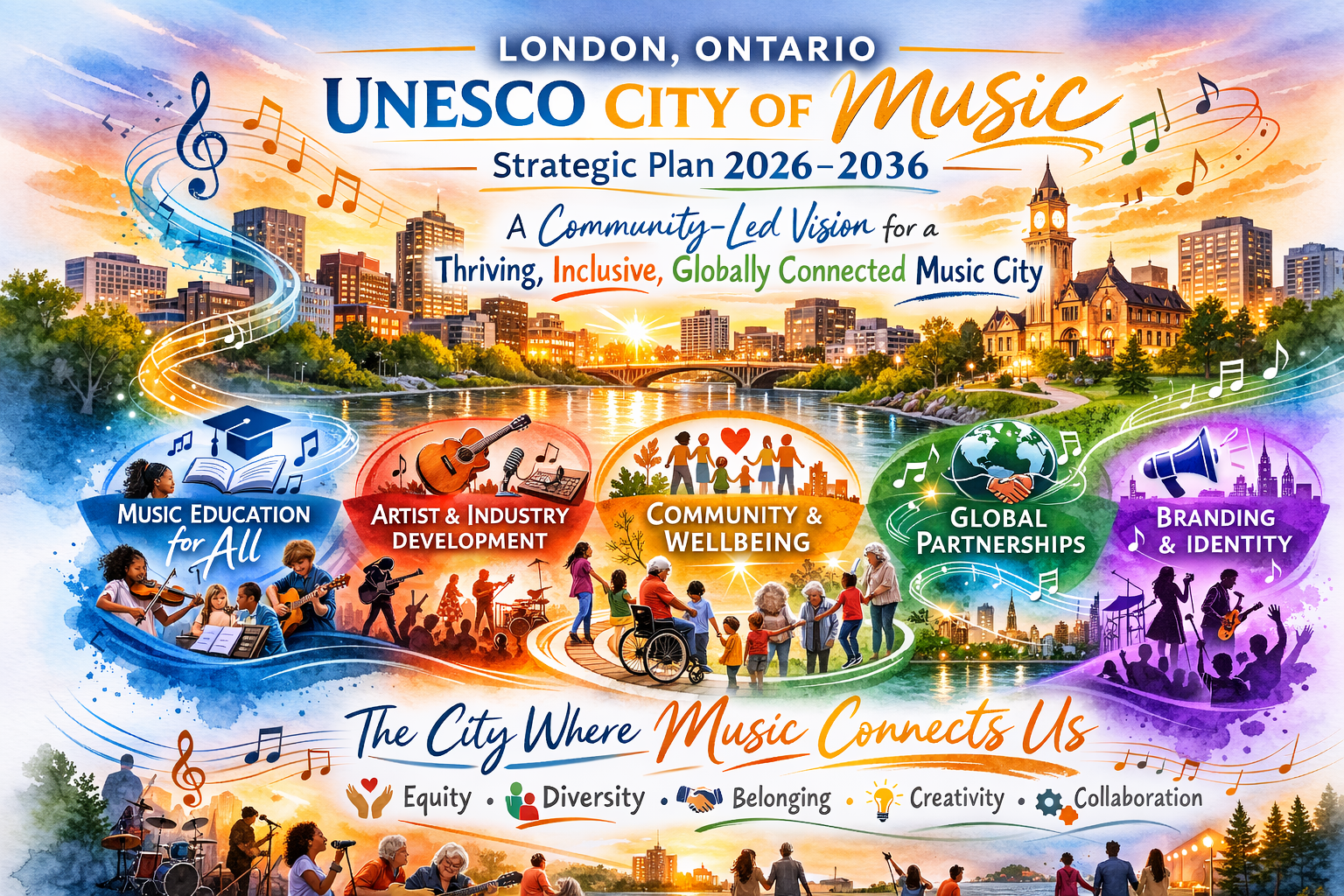
LONDON, ONTARIO – UNESCO CITY OF MUSIC
Strategic Plan 2026–2036
Prepared by Clark Bryan
A Community-Led Vision for a Thriving, Inclusive, Globally Connected Music City
EXECUTIVE SUMMARY
London, Ontario, Canada’s first UNESCO City of Music, is uniquely positioned to build a future where music is central to community wellbeing, identity, economic vitality, and cultural belonging. This 10-year strategy outlines a community-driven, equity-centred, globally aware approach to transforming London’s music ecosystem into a model for mid-sized urban cultural development worldwide.
The plan is built on five pillars:
- Accessible Music Education for All
- Artist Development & Creative Ecosystem Growth
- Community, Diversity, Intergenerational Connection & Wellbeing
- International & UNESCO Partnerships
- Branding, Marketing & Identity Building for London
The plan prioritizes:
- Diversity & Inclusion
- Newcomer engagement
- Youth leadership & mentorship
- Seniors & intergenerational music pathways
- Mental health & community wellbeing
- Climate-aligned cultural practices
- Collaborative governance & continuous listening
- Financial adaptability & realistic implementation
- A unified, values-driven London City of Music brand
Above all, this strategy affirms that:
Music is not merely an industry — it is a public good, a cultural language, a community asset, and a source of identity and belonging.
Economic development, tourism, and job creation will follow, but the heart of this plan is people, not profit.
1. INTRODUCTION & CONTEXT
1.1 London’s Identity Challenge
London has long struggled with its identity. “Forest City” no longer reflects its rapidly urbanizing, diversifying character. The name “London” competes with a world capital. Despite extraordinary creativity, many residents do not feel a coherent cultural narrative.
London is:
- A city of newcomers
- A city of youth
- A city of seniors and retirees
- A city of deep arts traditions
- A city with grassroots music communities
- A city with world-class learning institutions (Western, Fanshawe, OIART)
The UNESCO designation offers not a brand to adopt , but a story to tell: London is a city where music connects us.
This plan uses music as:
- A unifying civic identity
- A strategy for belonging
- A pathway to cultural empowerment
- A tool for reconciliation and intercultural dialogue
- A wellbeing and mental-health resource
- A catalyst for sustainable urban development
- A bridge to the global community
2. VISION, MISSION & VALUES
2.1 Vision
London is a vibrant, inclusive Music City where every person, regardless of age, culture, income, or identity, an access, learn, create, perform, teach, and enjoy music.
2.2 Mission
To cultivate an equitable, sustainable, community-driven music ecosystem that strengthens London’s identity, supports artists and educators, uplifts mental wellbeing, fosters intergenerational connections, amplifies diversity, and celebrates creativity as a public good.
2.3 Values
- Equity
- Access
- Diversity & Inclusion
- Community Voice
- Cultural Humility
- Lifelong Learning
- Creativity & Innovation
- Mental Health & Wellbeing
- Climate Consciousness
- Collaboration & Partnership
- Transparency & Accountability
- Belonging & Identity
3. STRATEGIC PILLARS
PILLAR 1: ACCESSIBLE MUSIC EDUCATION FOR ALL
Goal: Universal, equitable access to music learning across all ages.
1.1 London Music Education Equity Roundtable
Permanent but rotating body including:
- School boards
- Universities & Colleges
- Community programs (e.g., El Sistema Aeolian)
- Libraries
- Indigenous educators
- Newcomer organizations
- Seniors’ representatives
- Music educators (private and public)
Annual outputs:
- Music Access Map
- Education Gap Report
- Shared-access instrument inventory
- Recommendations to City of Music Council
1.2 Free & Low-Cost Community Programs
- Expand free programs in underserved neighbourhoods
- Subsidize transport + instrument rentals
- Multi-language offerings for newcomer families
- Accessibility supports
1.3 Lifelong & Intergenerational Learning
- Youth pathways
- Early childhood music
- Seniors’ beginner programs
- Family learning streams
- Intergenerational choirs & orchestras
1.4 Music Educator Professional Growth
- Annual summit
- Anti-oppressive practices
- Trauma-informed and adaptive pedagogies
- Cross-cultural repertoire development
PILLAR 2: ARTIST DEVELOPMENT & CREATIVE INDUSTRY SUPPORT
Goal: Empower London’s artists and creative workers to thrive.
2.1 Artist–Educator Residencies
Embed artists in:
- Schools
- Long-term care homes
- Community organizations
- Newcomer centres
2.2 Music Incubation Spaces
- Affordable rehearsal rooms
- Co-working spaces
- Micro recording studios
- Accessible arts facilities
2.3 Career & Business Development
- Entrepreneurship training
- Grant-writing clinics
- Music distribution workshops
- Digital literacy support
- Mental health supports for artists
2.4 Fair Pay Charter
- Minimum recommended fees
- Transparent wage guidelines
- Advocacy for sector labour rights
PILLAR 3: COMMUNITY, WELLBEING, INTERGENERATIONAL CONNECTION & DIVERSITY
Goal: Use music to build belonging, mental wellbeing, and intercultural understanding.
3.1 Neighbourhood Music Activation
- Music in Every Ward
- Pop-up stages
- Community choirs
- Outdoor festivals
- Library and community centre partnerships
3.2 Equity-Centred Programming
- Indigenous-led music initiatives
- Black and newcomer artist development
- LGBTQ2S+ music programs
- Disability-inclusive music practices
3.3 Seniors & Intergenerational Strategy
A core component of London’s Music City identity. Includes:
- Beginner-friendly seniors’ instrumental programs
- Intergenerational choirs
- Seniors-as-mentors initiatives
- Music therapy collaborations
- Cultural heritage ensembles
- Seniors’ music hubs
3.4 Music & Mental Health
- Hospital partnerships
- Music-in-healthcare initiatives
- Youth music therapy pilots
- Senior-isolation reduction programs
PILLAR 4: INTERNATIONAL & UNESCO PARTNERSHIPS
Goal: Strengthen global relationships that benefit Londoners.
4.1 UNESCO Exchange Programs
- Artist residencies abroad
- Educator exchanges
- Co-commissioned works
- Youth global collaborations
4.2 London City of Music Summit
Biennial gathering hosted in London with:
- UNESCO Creative Cities
- Canadian city partners
- Youth delegations
- Community leaders
4.3 Cultural Diplomacy
- Promote London’s diversity
- Showcase London artists internationally
- Build London’s reputation as a global mid-sized cultural leader
PILLAR 5: BRAND, MARKETING & PUBLIC NARRATIVE
Goal: Build a shared identity where Londoners see themselves reflected in the city’s cultural story.
5.1 Brand Concept
London’s new identity emerges from its people:
“London: The City Where Music Connects Us.”
Brand attributes:
- Diverse (especially important perspectives from Indigenous communities)
- Warm
- Community-driven
- Creative
- Intergenerational
- Newcomer-welcoming
- Proudly local
5.2 Internal Marketing (For Londoners)
- “Music Lives Here” campaign
- Newcomer Music Welcome Kits
- Music education directories
- Monthly “What’s On in Music” guide
- LTC bus/poster campaigns
- Neighbourhood activations
5.3 External Marketing (Outside London)
- Target GTA, Detroit, Cleveland, Buffalo markets
- Promote London as a music-learning destination
- Cultural tourism itineraries
- UNESCO-branded content
- International student recruitment messaging
5.4 Communications & Storytelling
- Real London stories from youth, seniors, newcomers
- Artist features
- Community-created videos
6. GOVERNANCE, COMMITTEES & COMMUNITY ACCOUNTABILITY
6.1 London City of Music Council
Permanent but Rotating Structure
- 12–18 members
- 2–3-year terms
- First cohort staggered:
- 1/3 serve 1 year
- 1/3 serve 2 years
- 1/3 serve 3 years
Membership Composition Includes:
Artists & Industry
- Musicians (multi-genre)
- Producers/technicians
- Venue representatives
Educators & Academics
- Western University
- Fanshawe College
- Private and community music educators
- Representatives from programs like El Sistema Aeolian
Community Representatives
- Youth (18–25)
- Seniors
- Newcomer representatives
- Indigenous leaders
- Community members (open call)
Institutions & Government
- City Councillor(s)
- Culture Office
- London Arts Council
- Tourism London
For-Profit & Non-Profit Representation
- Both required across the membership
Responsibilities
- Approve annual strategic priorities
- Ensure community-led direction
- Review public input
- Oversee accountability and equity frameworks
- Co-sign UNESCO reports
6.2 Working Groups (Permanent, Rotating Membership)
Standing working groups include:
- Music Education & Lifelong Learning
- Youth Leadership
- Seniors & Intergenerational Music
- Equity, Diversity & Inclusion
- Music Industry & Venues
- Mental Health & Wellbeing
- Sustainability & Climate Action
- International Partnerships
Members serve one-year renewable terms and are selected through open calls.
6.3 Reporting & Accountability
The Music Office must:
- Host annual listening assemblies
- Publish a Music City Dashboard
- Release a public annual report
- Present outcomes to Council, Arts Council, Tourism, and community groups
- Provide transparent budget allocations
7. LONDON MUSIC OFFICE – MANDATE & JOB DESCRIPTION (REVISED)
7.1 Mandate (Community-Led Model)
The Music Office is a facilitator, not a director.
It:
- Listens regularly and deeply
- Synthesizes community priorities
- Supports grassroots initiatives
- Facilitates collaboration
- Reports transparently
- Coordinates cross-departmental efforts
- Ensures community voices guide strategic direction
- Acts as a bridge between community, City Hall, and UNESCO
7.2 Reporting Structure (Collaborative Governance)
The Music Officer reports jointly to:
- City Manager
- Culture Office
- London Arts Council
- Tourism London
This ensures no single agency controls the strategy.
7.3 Music Officer – Full Job Description
Core Competencies
- Deep listening
- Cultural humility
- Facilitation & mediation
- Equity-centred leadership
- Transparent communication
- Strategic visioning
- Community trust-building
Key Responsibilities
Community Engagement
- Continuous consultation
- Sector listening sessions
- Participation in committees
- Direct support to equity-deserving groups
Strategic Stewardship
- Co-create strategic plans with community
- Adapt plans annually through consultation
- Manage UNESCO commitments
Data & Reporting
- Maintain Music Dashboard
- Publish annual reports
- Lead evaluation cycles
Partnerships & Representation
- Work across municipal departments
- Liaise with Arts Council & Tourism
- Coordinate academic collaborations
- Represent London internationally
8. IMPLEMENTATION PLAN (3, 5, 7, 10-YEAR)
3-Year (2026–2029) – Foundation
- Establish governance bodies
- Expand free music programs
- Launch seniors’ strategy
- Implement Music Access Fund
- Begin international exchange
- Launch community-led branding campaign
- Deliver Music City Dashboard
5-Year (2030–2031) – Expansion
- Intergenerational hubs in multiple neighbourhoods
- Full Music Incubation Centre launched
- London City of Music Summit
- Youth Leadership Academy
- International partnerships expanded to three cities
- Comprehensive cultural tourism offering
7-Year (2032–2033) – Integration
- Music education accessible in all wards
- Fair Pay Charter widely adopted
- Citywide intergenerational choirs/orchestras
- Five active UNESCO partner cities
- Climate-conscious festival guidelines in place
10-Year (2036) – Maturity & Legacy
- London recognized as global model for community-driven Music Cities
- Fully integrated lifelong learning system
- Intergenerational music as signature London feature
- Strong cultural identity replacing former branding struggles
- Thriving ecosystem supporting thousands of artists
- Deep belonging among Londoners across ages, cultures, and backgrounds
9. CONCLUSION
This 10-year UNESCO Music City Strategy redefines London’s identity around community, creativity, equity, diversity, and belonging.
By centering people over profit, community over hierarchy, and collaboration over control, London can become a Music City known not only for its talent, but for its heart, inclusiveness, and global leadership.
London will be a city where music connects us across age, culture, neighbourhood, and identity. A city where everyone belongs. A city where creativity thrives.
PHASE 4 — SPEECH FOR THE MAYOR / CULTURE OFFICE / MUSIC OFFICE
(Drafted as an example of a public facing vision)
“THE CITY WHERE MUSIC CONNECTS US”
Official Address for the Launch of London’s Music City Strategy
Delivered by the Mayor / Culture Manager / Music Officer
My fellow Londoners,
Today, we begin a new chapter in the life of our city — a chapter shaped by creativity, strengthened by community, and powered by the belief that every voice in London matters.
As Canada’s first UNESCO City of Music, London stands among cities around the world that use culture not as a luxury, but as a foundation for wellbeing, belonging, and identity. Being a Music City is not about spotlight stages or larger-than-life performers. It is about people — about you, your neighbours, your families, your stories, and the sound of a city growing together.
Music connects us. It connects generations. It connects cultures. It connects neighbourhoods. It connects those who have been here for decades with those arriving in London for the very first time.
Our new Music City Strategy is built on a simple but powerful idea: everyone deserves access to the joy, the learning, and the community that music brings.
This plan was shaped by listening — listening to artists, educators, young people, seniors, newcomers, Indigenous leaders, venue owners, and everyday Londoners who want to see their city thrive.
Together, we are building a London where:
- children can learn an instrument no matter their family income
- seniors can rediscover creativity and connection through song
- artists can build sustainable careers
- newcomers can share their culture and find belonging
- youth can lead, innovate, and shape our future
- and every Londoner can feel proud of the city we are becoming
Our identity will no longer be defined by confusion or comparison. We are not simply “London.” We are London: “The City Where Music Connects Us”.
This is our sound. This is our story. And it belongs to every one of us.
Thank you for being part of this moment. Let’s build this city together, in harmony.
PHASE 6 — THE MUSIC CITY PLEDGE (For Citizens & Organizations)
THE LONDON MUSIC CITY PLEDGE
I believe that music belongs to everyone. I commit to listening with openness, creating with joy, supporting artists and educators, welcoming diverse voices, and helping build a London where every person can learn, share, and thrive through music. Together, we make London the City Where Music Connects Us.
Rethinking Education: Ignorance, Freedom, and the Future of Democracy
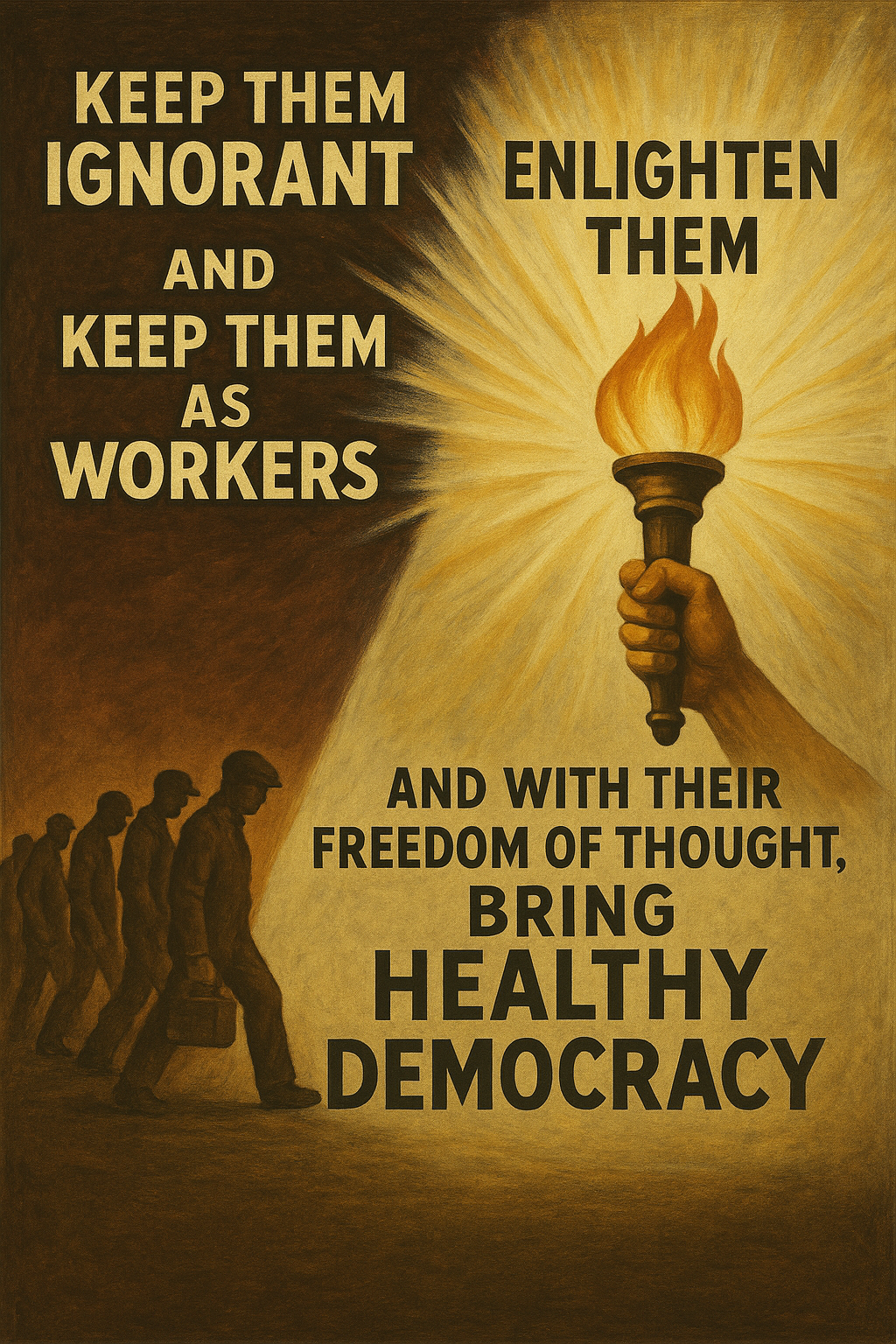
“If a nation expects to be ignorant and free, in a state of civilization, it expects what never was and never will be.” – Thomas Jefferson
“You don’t have to burn books to destroy a culture. Just get people to stop reading them.” – Ray Bradbury
“The illusion of freedom will continue as long as it’s profitable. When it’s no longer profitable, the illusion will be taken away, and you’ll see the brick wall at the back of the theatre.” – Frank Zappa
What Are We Really Teaching?
When we talk about “education,” we often mean curriculum, standardized tests, and professional training. But how often do we ask:
• What kind of knowledge are we passing on?
• Are we preparing students to think critically, adapt, and thrive in a changing world?
• How are we measuring well-being, mental health, creativity, or civic engagement?
Scoring well on standardized tests does not necessarily mean students are flourishing or prepared for the future.
The Narrow Scope of Higher Education
Take a university engineering student as an example:
• Will they learn about global politics, different cultures, climate change, or ethics?
• Will they explore compassion, empathy, or citizenship?
Most often, no—unless by chance, through an inspiring professor or peer environment. Without exposure to the arts, humanities, politics, and philosophy, can we really expect graduates to make informed democratic decisions or contribute fully to society?
Why Broad Education Matters
A broad-based education—history, arts, religion, philosophy, politics, and culture—is not a luxury. It is a foundation for democracy. Without it:
• Citizens lack the context to question systems of power.
• Elections become about slogans and personalities, not policies.
• Emotional manipulation replaces logic and debate.
This is not hypothetical—we already see it in populist rhetoric and simplistic political campaigns that appeal to fear rather than reason.
The Legacy of Control
Our modern education system was built in the 19th century to produce workers, not leaders. It fills “empty vessels” rather than fostering curiosity. Elite and private schools continue to provide advantages for the few, while the majority are trained to fit into existing systems rather than challenge them.
Historically, education has often reinforced power structures rather than disrupted them. From ancient China to modern democracies, elites have used education to maintain control, not broaden it. Only rarely do we see education used to truly empower citizens.
Canada’s Challenge
In Canada, students learn little about global politics, governance beyond Parliament, or non-European histories and cultures. Yet we live in a global economy. How can students become informed citizens without these perspectives?
Government control over curriculum, standardized testing, and even delivery methods means that pedagogy is shaped by political priorities—not necessarily by educators. Should elected officials without expertise in teaching decide what students learn?
The Consequences of Shallow Learning
• Students graduate without financial literacy, civic knowledge, or even an understanding of their own health.
• Critical thinking is underdeveloped, making people vulnerable to misinformation.
• Opinions often form from single sources or trusted friends, reinforced by a fixed mindset and resistant to evidence.
International tests like PISA try to link test performance to economic growth, but results are inconsistent. Some emerging economies grow rapidly despite low PISA scores, showing that education quality must be assessed in broader ways, including creativity, well-being, and peer learning.
What Needs to Change
If education primarily trains workers, how do we nurture entrepreneurs, innovators, and democratic citizens? By deliberately broadening curriculum and assessment to include:
• Civics and government (beyond one high school credit).
• Financial literacy, taught by trained educators.
• Arts, humanities, and global citizenship as central, not optional.
• Well-being, empathy, and real-life knowledge integrated throughout.
Education should be continuous—not ending at graduation. Lifelong opportunities for formal learning can help sustain democratic societies.
A Warning from the U.S.
The U.S. shows the risks of an unequal, divided education system. Wide gaps in equity and opportunity are undermining democracy. Canada must not follow this path.
⸻
A Vision for Canada
We need a curriculum that is:
• Equal: available to all Canadians, regardless of background.
• Global: teaching world history, politics, and culture alongside Canadian content.
• Holistic: valuing well-being, creativity, and the arts.
• Forward-looking: preparing citizens for entrepreneurship, sustainability, and democratic leadership.
By doing so, we can nurture citizens who are not only workers, but also critical thinkers, innovators, and stewards of democracy.
How Abraham Maslow’s Hierarchy of Human Needs” has led to the “Me Generations” and our current state of humanity: Individual Greed
I’ve been fortunate to spend some time with a dear friend Jim Wolfston from CollegeNET over the past few years. Jim is the founder of CollegeNET, an American Corporation heavily involved in social activism and developing tools to support higher education. He is a deep and brave thinker.
One of our latest conversations in light of the huge geo-political challenges the world is facing was centred around current challenges with President Donald Trump in the U.S. and the big question: how did we get here? Jim proposed something that was quite simple: the “me” generation(s).
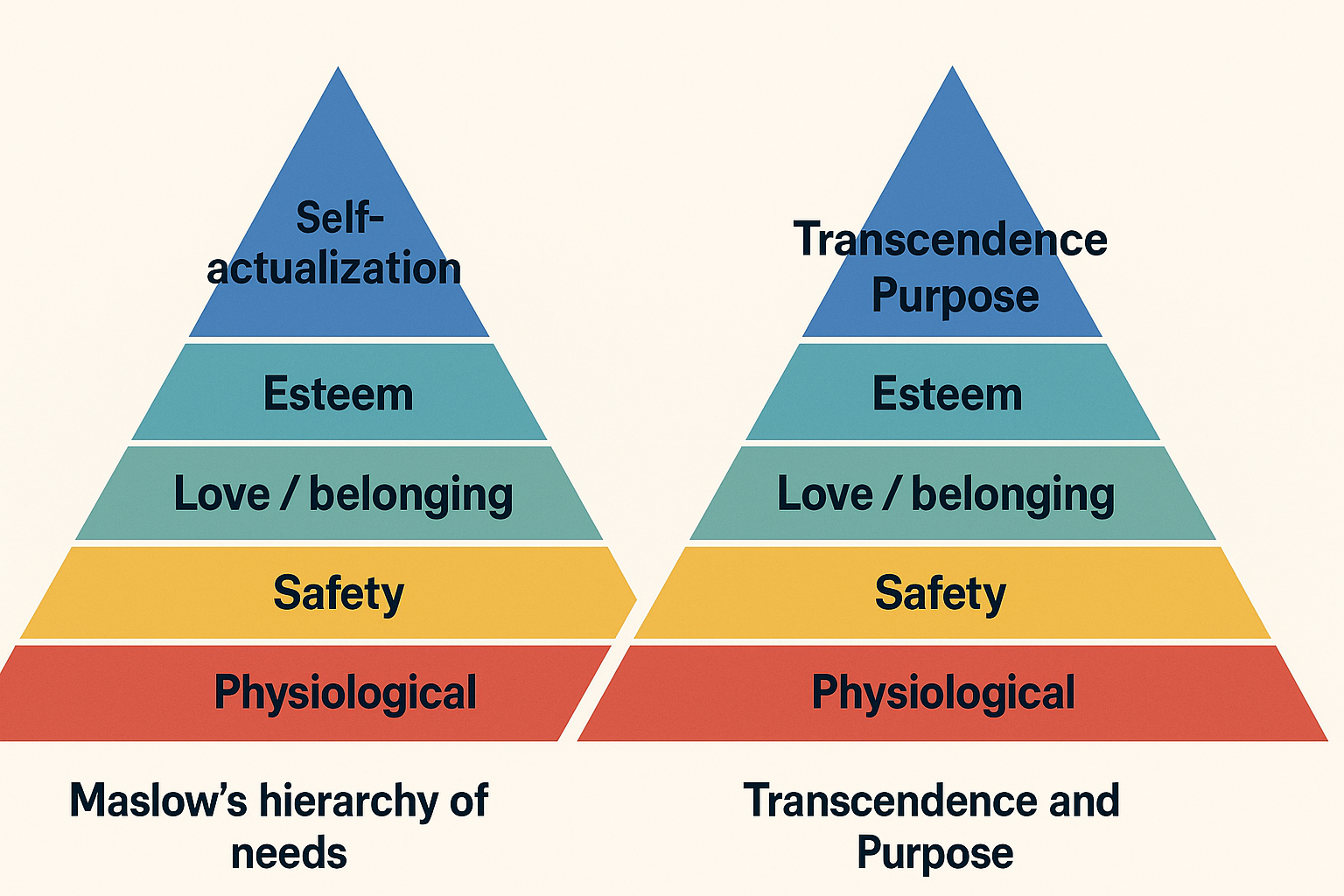
Interestingly, I happened to be reading a book by Victor J. Stretcher called “Life on Purpose”. In this book, Stretcher references Abraham Maslow’s Hierarchy of human needs. Maslow’s hierarchy is a pyramid of human needs beginning with basic safety, food, shelter and then moves up to “self-actualization” with a focus on “self-realization” and “self-fulfilment”
Stretcher writes: “This emphasis on an individual’s own actualization heralded the “me generation”-baby boomers intent on jogging, dieting, and meditating (or navel gazing, in the words of their detractors) to reach this “self-realization and self-fulfillment”.
Stretcher proposes that in the words of Viktor Frankl this “self-focus” was narcissistic and ultimately detrimental to the self.”
Stretcher continues:
“ Real fulfillment in life occurs only when a person transcends the self”.
Maslow changed his mind towards the end of his life about the “self-actualization”. Maslow wrote:
“The fully developed human being working under the best conditions tends to be motivated by values which transcend his self. They are not selfish anymore in the old sense of that term.”
Stretcher points out that Maslow then began to study “transcenders”. Maslow found that transcenders demonstrated “humility, a sense of ignorance, a feeling of smallness, awe before the tremendousness of the universe”. Stretcher points out that Maslow admitted that his original model was wrong.
Stretcher writes:
“These individuals were better able to see connections between disparate ideas, making them better innovators and discoveries.”
This shift from “self-actualization” now considers “purpose”. Purpose considers making contributions to the lives of others.
Jim Wolfston is right. The me generation has resulted in the erosion of interdependence, the caring about and for others. This focus on self and what “I can get” out of life has whittled away at the social safety net and promoted individual greed.
Let’s cultivate a new generation of “transcenders”. People with purposed that will help us solve humanity’s greatest crisis. We are at crossroads as a species. It’s time to work together and benefit “everyone” and not just the “one”.
The Future of Classical Music

I recently attended a conference in Berlin called “ClassicalNEXT” which tackled the issue of the future of classical music. It was very stimulating and filled with people from all over the globe. A real collective “think”.
I collaborated with a colleague from Finland hosting a roundtable discussion about innovation in music education including virtual tools and AI. Finland assesses music education and performance through peers more often than teachers.
As the world turns faster with the advancement of AI and its impact on everything, traditionalists have mixed reactions to this new tool and its implications. Some embrace it and see its potential for adding value to music and music education and others feel threatened by it and fear it will destroy traditions and steal ideas. One conclusion I heard from a presenter was that AI won’t take your job. People who know how to use AI will take your job. That was powerful and speaks to the task at hand: learn about it and how it might help you to be more efficient and get more ideas or….fall behind!
So what is the future of classical music in this new arena? One could ask about the relevance of all traditions in Arts and Humanities as AI dominates the conversation. I believe its future is strong and may be even stronger in the context of this new chapter in human development. The guidepost for these changes is always going to be about a moral compass. People can use technology for good and bad. We need to work hard to make sure that it is used for good. UNESCO has done a great job spelling out the ethical development of AI and I highly recommend visiting this resource. Here is a URL to that resource:
https://www.unesco.org/en/artificial-intelligence/recommendation-ethics
I ran a concert hall for over 20 years and have witnessed a lot concerning all of the music genres. From my perspective, there are a number of challenges to the future of classical music:
- Music Education: start young and establish the normality and appreciation for it. If a child picks up a violin now, they will likely support an orchestra later. They also did “that” and it becomes normalized and not privileged.
- Live music: get young people out to venues and establish a habit for going to them. Let them experience not only the music, but foster a sense of community and connectivity throughout the time they are there.
- Elitism: provide opportunities for classical music to be performed throughout communities and make it affordable or free.
- Musicians: don’t just show up and play and then disappear. Go out into the audiences whenever possible (before the concert, intermission and afterwards) and cultivate ongoing relationships with them. Talk about life, meaning and the music itself. Take the focus away from the performance outcome and focus on the emotions and intent, reactions and questions.
- Technology and AI: Technology has been with classical music for quite some time now. With the introduction of every new possibility, there have been those that are in fear and look to the past, and those who get excited and look to the future. Cultivate curiosity and engage with innovation. Become masters of it and see what is useful. Lead the innovation and don’t let the industry around classical music be led by the industry of technology. Even offer to co-develop it.
- Embrace fusion and innovation in music composition: Try to keep an open mind. Everything was new at some point and listeners either resisted or embraced the novelty.
- Interpretation: as Chick Corea once said to me: “Classical Musicians take themselves too seriously”. Is it a bad performance if the ornament comes before the beat or on it? Was the tempo unorthodox? Was the articulation out of “style”. Does any of this really matter? Is someone going to die from this? Is quality going to suffer if someone doesn’t get it right? We get so wound up with the “truth” that we forget the creativity and experiential part of music making. Cut some slack and listen to different perspectives; highly schooled or not. Foster music making and perspectives. It will make the art former richer!
- Attention spans: as we know, they are limited for many these days. Talk about the pieces you are playing and guide the listener. Don’t make it a “lecture” recital, but an open dialogue for preface and reaction. Don’t be afraid to have a conversation with your audience.
- Formality: let them clap where they like. Get used to it. Jazz musicians did and do. Lots can happen in a theatre. Young people can make noises at inappropriate times, someone could cough or sneeze, someone might need to get up at an inappropriate time and leave. Don’t glare and make them feel unwelcome. Try to find ways to foster a collaborative audience experience that includes real humans together and not the unrealistic expectations of silence. I’m sure everyone has their disruptive moment during a performance!
- The Genre: Classical Music is just music. It’s not until society tells the uninitiated that it is something else that it gets its elitist reputation. I ran a free afterschool music program “El Sistema Aeolian” for 14 years. We once took the kids to perform and interact with a budding group of Elementary Teachers at Teachers College, Western University. One of the teachers in training asked: what do you do with the prejudice against classical music. I responded: “Thanks a lot; they haven’t learned that yet!”
- Recordings versus Live: one isn’t better than the other. If a listener enjoys listening to recordings, it isn’t wrong. You shouldn’t tell them they are missing something. Invite them to a live concert and let them make up their own minds about the ways they want to enjoy music.
- Advocacy: there is growing research to show that the study of music and especially classical music helps with cognition and develops many skills that benefit people throughout their lives.. It’s not the authentic reason to study music, but a side benefit. Learning and playing classical music is about the joy factor!
These are a few ideas I have about the future of classical music. I would love to hear your perspective; traditionalist or not!
Canadian Values?

Many Canadians are waking up to the reality of having our values threatened. The United States President Donald Trump has expressed his desire to make Canada the 51st state of his country. It’s more important than ever that we define ourselves and our strengths so that we can fight against this geopolitical tyranny.
We talk about Canadian values, but does anyone spell them out? We could really use a moral compass right now and some leadership to remind us of that direction!
Here’s an attempt at spelling out Canadian values from my own personal perspective, but also from a lot of research:
Equality and Inclusion:
Multiculturalism: This policy was adopted in 1971, celebrating diverse cultures. Canada was the First Nation to adopt this policy.
Gender Equality: Equal pay and rights protections along with legal and social activism towards equity.
2SLGBTQ+AI Rights: Broad protections for the Queer community culminating in same-sex marriage in 2005. We were among the first countries to legalize!
Peace, Order and Government:
Our Constitution Emphasizes:
Social Welfare and collective responsibility
Cooperative Governance: between parties and levels of Federal, Municipal and Provincial Government
Stability of the rule of law: respect for the rule of law
Respect for Human Rights and the Rule of Law:
The Canadian Charter of Human Rights came into being in 1982, giving us civil liberties such as freedom of expression, religion and assembly
The Environment:
Policies to protect natural resources, sustainability and mitigate climate change
Bilingualism:
Canada is officially Bilingual
Reconciliation:
Canada is working towards reconciliation with its Indigenous peoples including land rights, languages and cultural heritage
Compassion and Social Responsibility:
Canada’s social safety net is an expression of fairness, equity and community caring
This includes education, public healthcare, Canada pension plan and much more
Democracy and Civic Participation:
Canada has a strong democratic tradition based on strong institutions, free elections and the cultivation of civil society.
Most Canadians believe in looking after each other. We aren’t perfect and have some really challenging social issues right now.
What’s different about Canada versus the United States?
Whereas the U.S. emphasizes individual freedom, self-determination and personal responsibility, Canada emphasizes collective well-being, social harmony and responsible governance.
Canada has a policy of multiculturalism and encourages cultural retention alongside integration, whereas the
U.S. is a melting pot model for assimilation into a unified American identity. Canada celebrates diversity in official institutions whereas the U.S. often debates diversity politically.
Canada has a universal public healthcare and strong social welfare programs, whereas the U.S. has limited supports preferring to focus on charity or private initiative.
Canada has strict gun control laws, regulated and limited, whereas the U.S. see guns as a symbol of freedom and self-reliance.
Canada views itself as a peacekeeping cooperative nation with an identity shaped by moderation, diplomacy and tolerance, whereas the U.S. is shaped by independence, exceptionalism and ambition.
Canada is more secular in public life and government policy, whereas the U.S. has strong influence by religious groups on social issues and elections.
It’s important that we work to clarify, teach and really own these values that have evolved in our great country. We must fight to protect them and ensure we continue to work towards a more inclusive, diverse and equitable society.
Education Inequality equals Social Unrest
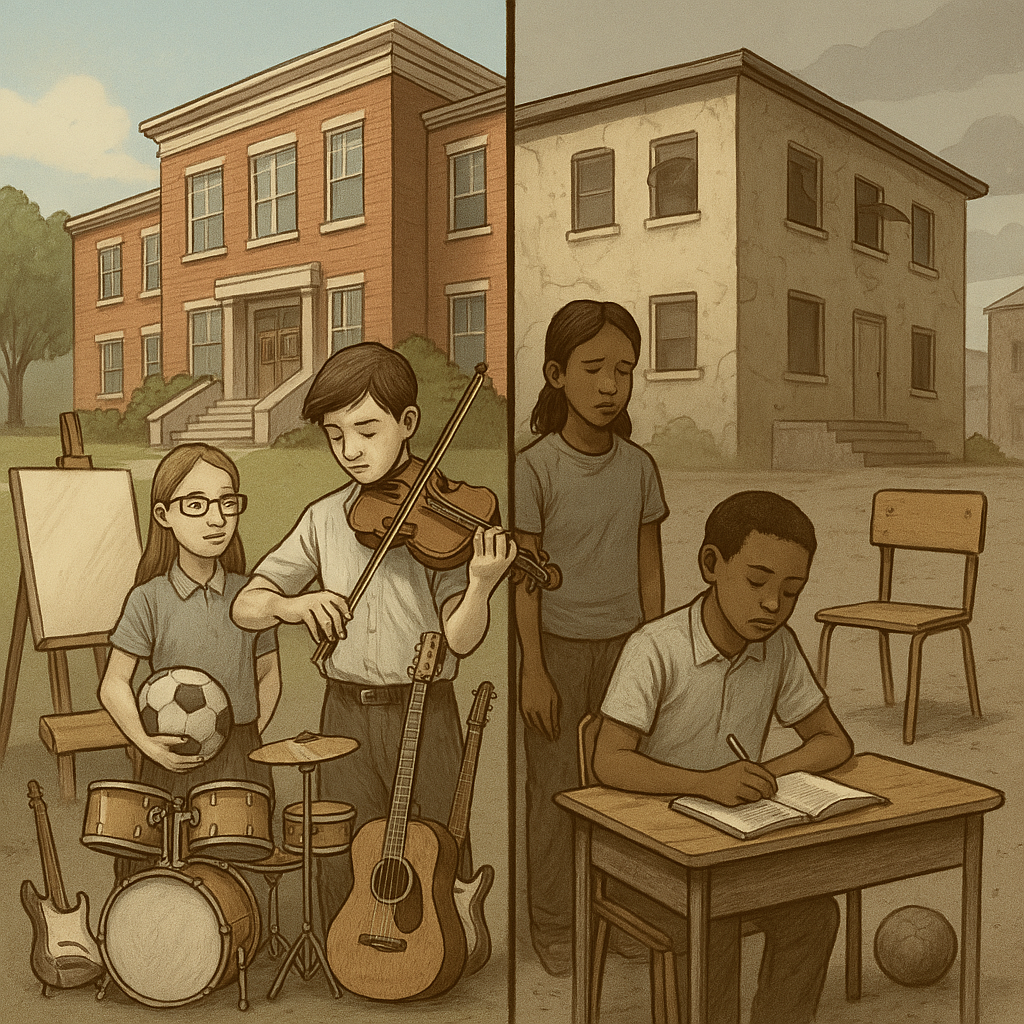
Throughout history, opportunities for great education have been limited to the few. Public education was put into place in large part to feed commerce. It has served to prepare workers for the workforce. The workforce was needed to create things for companies owned by the elite, wealthy and powerful people in our societies. Those from wealthy families could afford to send their children to elite schools and have them graduate to positions of power in both industry and politics. Having wealth was often the ticket to both higher education and power. As demonstrated in recent times, students from wealthy families have paid extra money to institutions of higher education in order to guarantee entrance for their children to those institutions. Not only can this wealth guarantee entrance to these institutions, but it can also guarantee the marks needed for graduation.
How are we doing in Canada? Are all schools equal and access equitable? Let’s start with elementary schools and high schools.
There are a growing number of schools that are marginalized by social-economic classes. These are the schools that don’t have parents who can fundraise for school trips or extra school equipment. These are the schools that don’t have enriched arts programs and have few if any afterschool extra-curricular activities. In Ontario, it’s up to the Principal of the school as to whether or not there are arts programs! No equity at all!!
Although the curriculum for all provinces in Canada includes the arts, if there is no arts specialist (such as music specialist) on staff, its up to the individual teacher how they will manage or not manage to teach music. In countries like Finland, Arts education is considered a human right and there are specialists in each school as well as 97 publicly funded music schools for an afterschool education opportunity. Of course there is also music in their public schools….each and every one. Teachers in Finland must have at least a Masters Degree to teach and it is a highly competitive profession where only about 10% of those who apply get the opportunity to teach. Music and Arts specialists exist in every school there.
Scientists at Standford and education specialists around the world have clearly stated that our future will rely on creative entrepreneurs. They will create the new economy and tackle our social and environmental challenges. Daniel Pink in his book “A Whole New Mind” makes creative education his thesis and the basis for his arguments about the type of economy that’s ahead of mankind. Manufacturing jobs will become scarce as automation and AI take over. Entrepreneurs who have been steeped in creative risk-taking and the skills needed will form a new economy based on invention.
Creativity comes in large part from the arts and not as much from STEM education. This is a supporting reason to include the arts as an essential part of our education curriculum and make that education happen! The fundamental reason for the inclusion of the arts in core curriculum is that it is equitable and good for us. It brings joy and fulfillment to our lives. Kids are often motivated to get out of bed and go to school for arts curriculum… more often than STEM curriculum.
Knowing that some families and children have access to an enriched education and other don’t, how do parents feel about this? The working class might not even notice as they are busy trying to hold their lives together. But when they do, I’m sure outrage and action is ahead. The United States is a great example of this. There are huge social-economic divides in the U.S. and there is a rising “us and them” political and cultural civil war happening as a result. Education equity is a huge factor creating this divide. This is not good for society or the economy. Let’s not let Canada slip further away, but act with awareness to ensure that we fight for equitable education for all Canadians! How? Start conversations about it. Talk to your teachers, school boards, family and governments and insist that what we are doing does not align with Canadian values. Protest and vote for the change. Change comes when you drag the politicians into it!
If you meet the Buddha on the road, kill him!
Sheldon Kopp’s book with this title is definitely worth the read. The title actually comes from the 9th century Chinese Buddhist monk Linji Yixuan. I read it about twenty or more years ago and it was definitely food for the soul. The thesis in this title proposes rejecting external authority and dogma and instead trusting in your own experience and understanding.
In our culture here in the western world, we’ve largely moved away from the worship of an external god. Yes, many still believe and follow religions, but the worship has become more overtly directed at humans. A great example of this is the “Rock Star” of professions like sports, entertainment (actors), leaders and those who obtain large amounts of wealth. We want to follow them, be like them and think about them often when reflecting on our own lives. We also pay a lot of money to hear and see them. We talk about them incessantly and idolize their lives and achievements.
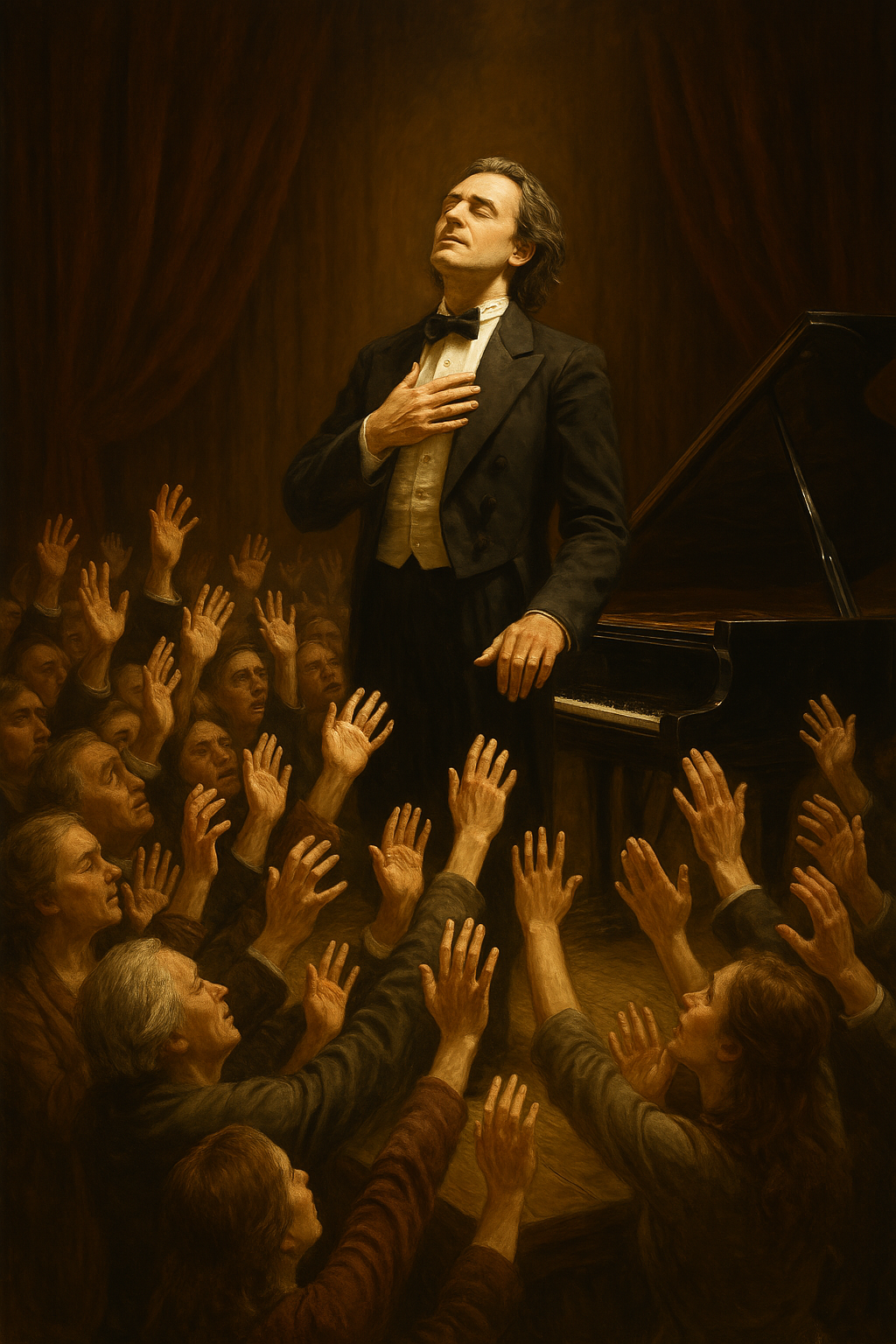
Having been steeped in the classical traditions of piano playing, those “Buddhas” are the composers, the great interpreters/performers, the great teachers that we bow down to. They are like gods to many. We worship the way they play or write music. Of course, great wealth and cult followings envelop these personalities. Historically, one can find concert halls filled with the “who’s who” in the audience: the worshipers. Sometimes the worshipers aren’t even interested in the art form/performance, they are just interested in being part of an experience where they can be seen as appreciating the “greatness” as presented. Even if it isn’t greatness, sometime worshipers follow because others do, wanting to be part of the crowd; sheep following the shepherd. It’s a bit twisted, don’t you think? These perceived giants are just people like everyone else struggling with their own lives. I’m not diminishing the authentic experience of listening to great music and being brought to tears, but how often do you see classical audiences react in authentic ways to the performance. Traditionally, it’s sit still, don’t move, and be quiet for fear you bother someone. It can even be about building Cultural Capital; connections through classical music to be exploited for other purposes.
I remember when the great musician/pianist Chick Corea came to perform at Aeolian Hall for the first time (28 Grammy Awards) and we had dinner together. Chick loved classical music, but he made a statement to me that I’ll never forget:
“Classical musicians take themselves too seriously”.
I asked him to explain this and he reflected on his own journey with classical music (incidentally, this was his greatest passion) and the culture he experienced.
He lamented the inauthentic pursuit of the best performance, the closest adherence to the written text and the elusive “truth” of the very best musician or interpreter of a work. Don’t you dare change a single note or detail the composer has written. It is a sacred text to be venerated and worshipped.
Then there are the composers. Throughout my career I get asked questions like: “who’s your favourite composer….pianist….work of music etc.” “What was the very best performance you ever attended?” Not a lot of talk about how the music or how performance affected your spirit. Authenticity is often completely lost here! It seems like it’s more like “collecting and possessing” than “experiencing and reflecting”. “Oh, that performance in Berlin that I attended of Turandot was certainly rated as the best ever presented…and I was there!” Aren’t I great and special?”
Then there’s the competitions. So many of them now and so many winners. Before international competitions, artists were recommended by their peers for their capabilities and artistry. Now it’s the olympics for the arts. Having art as a competition is antithetical to the creative process.
I worked for years with the great French pianist Cécile Ousset. She sat on the juries of many of the big competitions and had participated in competitions in her youth. I asked her how a decision was made to choose winners. She said: “we choose someone with a lot of experience”. I then asked her: “Why don’t we make competitions for older players who have lots of experience”. She said: “That’s a great idea”.
Completely messed up, right?
I also asked Mme Ousset if the jury ever heard much interesting playing. She said: “no, rarely”. Often Competitions make artists choose winning interpretations rather than their own authentic ones. Playing something in a way that pleases the most or working on technical perfection over spontaneous risk taking.
I hope society can find space for arts for “arts sake”. The creative process as being one of truly “living and experiencing” rather than worshipping and winning. We will all grow immensely and find our creative outlets if we return to building who we are with great authenticity.
Wisdom for our time: The Dao De Jing
How Leaders Should Act
If you don’t know the writings of Laozi in the Tao Te Ching from approximately 500-300 BCE, it’s worth getting to know them. This is considered by most learned people to be one of the greatest philosophical works ever written.
I was drawn to a particular chapter today that seemed wisdom for world leadership:
“If anyone with the aspiration to rule the world exerts efforts toward this,
I perceive this will most likely be unattainable.
Oh, the world is a Venerated Object,
upon which no effort can be exerted-
they who exert effort upon it will fail, and they who grasp at it will lose.
Things can be either advancing or following,
hot or cold,
tough or bowed,
waxing or waning.
And for this reason sages will
dispense with exaggeration,
dispense with extravagance.”
(translation by J. H. Huang)
What does this all mean? There is no one who has the power to dominate the world. We must treat the world with absolute reverence as our lives are reliant upon it. We must not claim dominion over things as they must exist as they are. If we don’t follow this path, every achievement will be in vain and we might even destroy the world. In their own way, all things exist beyond our control. That is why leaders need to accommodate the world as it is.
There is wisdom to follow from many sources that can correct mankind’s misguided pathways. Education is key to saving our world…but a different kind of education than we find in our school systems. An education based on humanism, wisdom and respect for the Dao (or whatever you believe is the source of enlightenment). An education that helps us all understand how to treat the world and each other with respect and dignity. An education that prevents a domination over others and the world we live in.
Ideas for Practicing Music
There are boundless books, videos, courses and more about how to practice music. How can we choose a way that works for us personally? Or is there just one way we should all practice?
The old school teacher would often have one approach that was mandated for the student. Often, no questions asked. In other words, let’s fill the empty vessel! This was passed on through the hundreds of years and thought of as a legacy. “I’m from the Viennese School” of piano playing” or “I have been taught the true bel canto approach to singing”. Better still, “I’m from the Anton Rubinstein lineage of piano playing” or in more recent years, “I’m an Alexander Technique practitioner. Disciples of hundreds, if not thousands of “schools” or “lineages” still abound!
If you’ve had a teacher, you’ve probably been told to practice at home. The really old-school way is basically just that: practice….and a lot! It’s a bit limiting and doesn’t help if you get stuck or aren’t sure how to break down practice projects and goals. It was all about hours spent and not necessarily well spent.
There is a saying: “Practice makes Perfect”. It’s actually quite a lie. Only perfect practice makes perfect. “Practice makes permanent” is closer to the truth. If you practice something the wrong way, it stays stuck in those neural-pathways. One has to work a lot harder to undo those bad connections and re-wire the brain with a good connection.
So now, down to the plan. First off, stay open. Don’t get a fixed mindset about how you go about learning. As lots of questions both to yourself and to your guides. See what works for you. Give things time. Something might not seem reasonable now but with lots of practice might seem great later.
Listen and watch great musicians. Not just the ones playing your chosen instrument. Learn a lot of music. I mean thousands of pieces of music. A musician is one who knows music. An instrument player like a “pianist” or “singer” knows how to play, but doesn’t necessarily know music or have great musicianship skills.
Motivation is not the tool that makes for great practice. Some days we are motivated and others we are not! Habits are the key; things we do daily like brushing our teeth-whether we like to or not! There is a great book I recommend to my students for habit formations: Atomic Habits by James Clear. The saying: “showing up is half the battle” rings true!
Getting organized for your practice with lists of goals and time units is also fundamental. There are many books and apps that can help structure good lists. A few I recommend are: The Checklist Manifesto by Atul Gawande, Keep it Going by Austin Kleon and The 5 Types of Wealth by Sahil Bloom (this is really fantastic for much more than organizing priorities for lists!). An online app like Todoist is also extremely practical. A practice journal at your instruments side is also helpful for jotting down accomplishments as well as goal setting for each practice session.
Being well rested, without distractions and excited to learn is critical to foundations for good practice. Excitement and enthusiasm help carve out those neural-pathways, but carefully coached repetition is critical. We can’t always practice with a real coach at our side, so we have to become our own coach using critical thinking. Checklists help with this. Asking questions like:
How was my note accuracy?
How was my rhythmic accuracy?
How was my articulation?
How is my balance?
Am I voicing the right notes?
How’s my pedalling?
How’s the style?
Am I paying attention to rubato and other tempo signs?
The list goes on and on. Each repetition can focus on a different aspect, shifting our perspective and helping us know the notes better in different ways.
Malcolm Gladwell publish a book called “The Tipping Point” that discussed the 10,000 hours needed to mastery of something. Although his observations have had some controversy in recent years (exactly how long it takes), we know that years of practice are key to proficiency at the very least! Being psychologically ready to embrace this kind of longterm discipline is critical to success. In other words, having the patience to wait for an outcome and not just throw up your hands and say “it didn’t work for me” or “I really have no talent for it”.
Anders Ericcson wrote a book called “Peak” which is all about practice. I highly recommend reading and applying the principles in this work. Ericcson dispels the concept of the “prodigy” and instead looks at three things:
The goal
The coach
The practice
These are just a few thoughts about “How to practice”. It’s not a manual or a program, just concepts to put into practice. There’s no “Hack” for the work that needs to happen, nor is there any guarantee that some of the practice won’t be boring or tedious. There will be days when you don’t want to practice. We all feel this way sometimes. Those who succeed are the ones who practice anyway!
Happy Practicing!
 Clark Bryan